AI Year in Review 2024
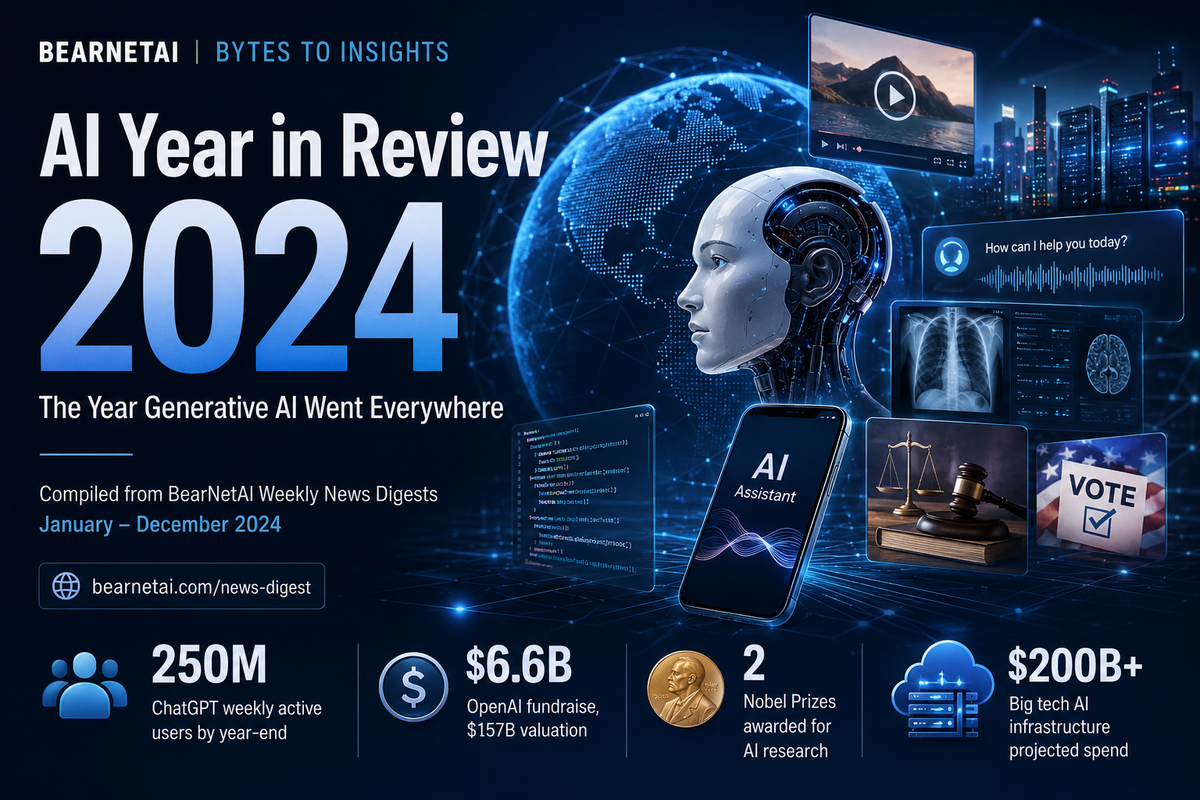
BearNetAI | Bytes to Insights
The Year Generative AI Went Everywhere
Compiled from BearNetAI Weekly News Digests | January – December 2024
bearnetai.com/news-digest
Introduction
If 2023 was the year the world discovered generative AI, 2024 was the year it had to decide what to do with it. The technology spread from research laboratories and technology companies into hospitals, courtrooms, election campaigns, military operations, retail stores, and financial institutions. Models grew more capable and more affordable at the same time. Regulation moved from discussion to legislation. And a set of social, ethical, and economic questions that had previously seemed abstract became urgently real.
The pages that follow draw on the full year of reporting in BearNetAI's Bytes to Insights weekly digest, tracing the major developments that shaped AI from January through December 2024. It was a year of genuine breakthroughs, historic recognitions, accelerating investment, and the first serious attempts by governments around the world to govern a technology whose pace of change outran every framework designed to contain it.
2024 at a Glance
|
250M ChatGPT weekly active users by year-end |
$6.6B OpenAI fundraise, $157B valuation |
2 Nobel Prizes awarded for AI research |
$200B+ Big tech AI infrastructure projected
spend |
Q1 2024: Sora, Gemini, and the Multimodal Turn
January–February: Sora and the Video Frontier
OpenAI opened 2024 with one of its most arresting demonstrations yet: Sora, a text-to-video generation model capable of producing short cinematic clips from written prompts. Announced in February, Sora represented a qualitative leap beyond the jittery, artifact-laden video outputs that had characterized the field and signaled that generative AI was about to enter the visual storytelling space in earnest. The company made it available initially only to red teamers and a small cohort of creative professionals, citing the need to assess risks around realistic synthetic media before wider release.
The Sora announcement arrived alongside intensifying model competition. Google formally launched Gemini 1.0 Ultra, its most capable model, positioning it as a direct rival to GPT-4 and marking the clearest signal yet that the search giant intended to compete at the frontier rather than cede it. Gemini was notable for its native multimodality, designed from the ground up to process text, images, audio, and video rather than grafting those capabilities onto a language model after the fact.
|
Key Moment OpenAI's February 2024 announcement of Sora, capable of
generating realistic video from text prompts, signaled that generative AI was
about to transform not just written and visual content but the entire medium
of moving images, raising immediate concerns about synthetic media and the
integrity of video as evidence. |
March: Claude 3 and the Model Quality Race
Anthropic released the Claude 3 family in March 2024, comprising Opus, Sonnet, and Haiku, spanning from maximum capability to lightweight efficiency. Claude 3 Opus outperformed GPT-4 on a range of standard benchmarks and was widely noted for stronger performance on graduate-level reasoning tasks, coding, and nuanced analytical work. The tiered release reflected an industry-wide recognition that different use cases required different cost and performance profiles, and that frontier capability alone was no longer sufficient to win enterprise adoption.
The Claude 3 release intensified a pattern BearNetAI tracked throughout the quarter: AI labs releasing increasingly capable models in rapid succession, with each release triggering a round of benchmark comparisons, capability demonstrations, and revised projections about how quickly the technology was advancing. The pace of improvement was difficult to communicate to a general audience, since the benchmarks used to measure progress were themselves becoming saturated faster than new, harder ones could be designed.
March–April: The Election Year Anxiety Begins
With 2024 shaping up as one of the most consequential election years in modern history, including national votes in the United States, United Kingdom, India, and dozens of other countries, BearNetAI began tracking the growing concern about AI-generated disinformation and deepfakes in political contexts. Foreign actors were reported to be deploying generative AI to produce misleading content at scale, including synthetic audio clips that mimicked the voices of political figures and fabricated video footage designed to manipulate public opinion.
The threat was not merely hypothetical. BearNetAI's Fact Bytes: AI Disinformation Exposed series, launched to track these developments in real time, documented multiple cases of deepfake content circulating across social platforms during the early months of the year. The central challenge, as BearNetAI reported, was that detection methods lagged behind generation capabilities: the tools available to identify synthetic media were consistently outpaced by the systems producing it. Fact-checkers from outlets including BBC Reality Check and Reuters were among the organizations working to identify and debunk fabricated content, but the volume was straining their capacity.
Q2 2024: GPT-4o, the EU AI Act, and Apple's AI Moment
May: GPT-4o and the Omni Model
OpenAI's Spring Update in May 2024 delivered GPT-4o, the company's first natively multimodal model, where the letter o stood for omni, reflecting its ability to accept and generate text, audio, and images within a single unified architecture rather than through separate modules bolted together. The launch demonstration was notable for a voice assistant that could adjust its emotional register, respond with apparent empathy, and interact in a register that felt notably more natural than anything previously available. The model was made available to free-tier ChatGPT users for the first time, marking a meaningful democratization of frontier AI capability.
The GPT-4o release prompted an immediate wave of commentary about what a genuinely conversational AI interface might mean for human relationships with technology, and what risks a more emotionally convincing AI voice might carry. Former Google CEO Eric Schmidt, in remarks covered by BearNetAI, later in the year warned that AI chatbots designed to serve as companions, including so-called perfect girlfriends, risked exacerbating loneliness among young men by substituting for the harder work of genuine human connection.
|
Key Moment GPT-4o's May 2024 release introduced the first natively
omnimodal architecture capable of processing and generating text, audio, and
images, and made frontier AI available on the free tier of ChatGPT for the
first time, fundamentally changing who had access to the technology and at
what cost. |
May: The EU AI Act Becomes Law
After nearly three years of negotiations, the European Parliament formally adopted the Artificial Intelligence Act in May 2024, making the European Union the first major jurisdiction in the world to enact comprehensive binding regulation of artificial intelligence. The law created a risk-tiered framework, banning applications deemed to pose unacceptable risks including real-time biometric surveillance in public spaces, while imposing transparency and documentation requirements on high-risk systems deployed in areas such as credit scoring, employment, and medical devices. Providers of general-purpose AI models above certain capability thresholds faced additional obligations.
The AI Act was both celebrated as a landmark and criticized from multiple directions. Industry groups argued that the compliance burden would disadvantage European AI companies relative to American and Chinese competitors. Civil liberties advocates contended that the permitted exceptions for law enforcement surveillance were too broad. AI safety researchers questioned whether the risk categories as defined captured the most important potential hazards. BearNetAI's reporting on the Act framed it as a foundational document with enormous uncertainty about how its provisions would be interpreted and enforced in practice.
June: Apple Intelligence and the Mainstream Moment
Apple's Worldwide Developers Conference in June 2024 brought what many observers had been waiting for: the world's most widely distributed consumer technology company formally entering the generative AI race with Apple Intelligence, a suite of on-device and cloud AI features designed to integrate with iPhone, iPad, and Mac. The announcement included a partnership with OpenAI to bring ChatGPT capabilities into Siri, representing an extraordinary moment in which two companies that had been wary of each other forged a significant commercial alliance around AI.
The Apple announcement had two immediate effects that BearNetAI tracked closely. First, it confirmed that generative AI was moving from the early-adopter phase into mass consumer deployment, at a scale measured in billions of devices. Second, it intensified the competitive pressure on Google, which had long relied on its search and advertising relationship with Apple as a foundational element of its business model. The arrival of AI-powered search and assistance features in the iPhone threatened to reshape that relationship fundamentally.
Claude 3.5 Sonnet was released by Anthropic in June 2024, outperforming Claude 3 Opus on most benchmarks at significantly lower cost, demonstrating the continuing efficiency improvements that were making frontier-class AI more economically accessible for enterprise deployment. The summer of 2024 saw model capabilities advancing at a pace that made benchmarks obsolete almost as soon as they were published.
Q3 2024: Reasoning Models, Safety Summits, and a $6.6 Billion Bet
July–August: Gemini 1.5 and the Context Window Revolution
Google's Gemini 1.5 Pro and Flash models, refined through the summer months, demonstrated something that challenged assumptions about what AI could do with long documents: a context window of one million tokens, capable of processing and reasoning across entire books, codebases, or hours of audio in a single interaction. The capability shift was significant not just as a technical benchmark but as a signal about how AI systems would increasingly be used, not as chatbots responding to brief queries but as analytical engines capable of synthesizing vast bodies of information.
The summer also brought intensifying attention to the energy and infrastructure demands of AI. BearNetAI reported on projections that big technology companies collectively planned to spend more than $200 billion on AI infrastructure by 2025, with data center construction, power procurement, and chip acquisition absorbing capital at rates that strained supply chains and raised environmental questions about the technology's long-term sustainability. Nvidia's dominance in AI accelerator chips continued to make it the most consequential company in the AI supply chain.
September: OpenAI o1 and the Reasoning Breakthrough
The most technically significant model release of the third quarter was OpenAI's o1, codenamed Strawberry during development, which debuted in September 2024. Unlike previous models that generated responses quickly using pattern completion, o1 introduced a deliberate reasoning process in which the model worked through problems step by step before producing a final answer, achieving dramatically higher scores on graduate-level science and mathematics benchmarks in the process. On MedQA, a medical knowledge benchmark, o1 reached 96 percent accuracy, a 5.8 percentage point gain over prior state of the art and a level that surpassed average clinician performance.
The o1 release prompted intense debate about what the reasoning capability represented. Optimists argued that it demonstrated a path toward more reliably correct AI on complex analytical problems. Skeptics noted that the model was still prone to confident-sounding errors on problems outside its training distribution and that the step-by-step reasoning, while more transparent, was not equivalent to the kind of principled understanding that would be required for genuine general intelligence. BearNetAI covered both perspectives, noting that the benchmark performance, while impressive, did not resolve the deeper questions about whether language models could reason in a generalizable sense or merely simulate the appearance of reasoning on problems similar to their training data.
|
Key Moment OpenAI's o1 model, released in September 2024, introduced
deliberate chain-of-thought reasoning as a core architectural feature,
achieving 96 percent on MedQA and raising new questions about whether AI
systems were approaching genuine analytical capability or producing more
convincing simulations of it. |
September–October: OpenAI's $6.6 Billion Fundraise and Structural Crisis
OpenAI concluded a landmark fundraising round in late September and October 2024, raising $6.6 billion at a valuation of $157 billion and making it by a wide margin the most valuable private technology company in the world at the time. The round included investments from Nvidia, Microsoft, and a range of sovereign wealth funds and institutional investors. The company simultaneously announced its intention to convert from a nonprofit-controlled structure to a for-profit public benefit corporation, a transition that proved significantly more complicated and contentious than initially indicated.
The fundraise was accompanied by a wave of high-profile departures that shook the organization. Chief Technology Officer Mira Murati announced her resignation in late September, followed by several other senior researchers and executives. The departures fed speculation about internal tensions over the pace of development, the safety culture, and the governance changes associated with the for-profit transition. BearNetAI noted that the juxtaposition of record-setting fundraising and significant leadership instability illustrated the paradox at the center of OpenAI's situation: enormous investor confidence in its commercial potential coexisting with unresolved questions about its organizational direction.
October: The Seoul AI Safety Summit
International AI governance efforts advanced through the Seoul AI Safety Summit in May 2024 and continued work through the year on the frameworks established at Bletchley Park in 2023. Governments and major AI laboratories signed agreements committing to share safety evaluations of frontier models with one another and with national AI safety institutes. The United States AI Safety Institute, established in 2023, deepened its evaluation work, and equivalent bodies in the United Kingdom, European Union, and a number of other countries built out their capacity to assess advanced AI systems before public deployment.
The governance work was meaningful but also revealed the limits of voluntary international coordination on a technology where competitive pressures were intense and enforcement mechanisms were weak. BearNetAI's reporting on the governance landscape consistently noted the gap between the pace of policy development and the pace of technological change, a gap that widened noticeably during 2024 as capabilities advanced faster than anticipated.
Q4 2024: Nobel Prizes, Elections, and the Year's Close
October: Two Nobel Prizes for AI Research
October 2024 brought a historic double recognition of AI research from the Royal Swedish Academy of Sciences. The Nobel Prize in Chemistry was awarded to Demis Hassabis and John Jumper of Google DeepMind for their work on AlphaFold, the protein structure prediction system that had effectively solved a problem that had defeated structural biologists for fifty years, and to David Baker for his complementary work on computational protein design. The Nobel Prize in Physics went to John Hopfield and Geoffrey Hinton for foundational work on neural networks that had made modern machine learning possible.
BearNetAI covered both awards in depth, noting that AlphaFold's Nobel recognition validated not just a specific system but an entire approach to scientific discovery through AI. The AlphaFold database, which had grown by 585 percent since its launch, contained predicted structures for virtually every catalogued protein, and had already accelerated work in drug discovery, materials science, and fundamental biology. The physics prize for Hinton carried an additional dimension: Hinton had left Google in 2023 specifically to speak more freely about the existential risks of advanced AI, making him the first Nobel laureate to have publicly raised concerns about the technology for which he was being honored.
|
Key Moment The 2024 Nobel Prizes in Chemistry and Physics both recognized
AI research, with AlphaFold winning the chemistry prize for solving protein
structure prediction and Hopfield and Hinton receiving the physics prize for
their foundational contributions to neural networks, representing the most
significant official validation of AI as a scientific enterprise in the
field's history. |
November: The U.S. Election and AI's Political Reckoning
The United States presidential election in November 2024 arrived after a year in which AI-generated disinformation had been a persistent concern. BearNetAI's Fact Bytes series had documented multiple waves of synthetic content targeting American voters throughout the year, including AI-generated audio fabrications of candidates' voices, realistic video deepfakes designed to mislead about candidates' statements and positions, and AI-powered fake job scams and phishing operations that used the election as cover. Foreign actors from multiple countries were identified as using generative AI to produce misleading content at a scale and speed that would have been impossible with human content creation alone.
Donald Trump's election victory carried immediate implications for AI policy that BearNetAI reported with particular attention. The incoming administration had signaled clearly its intention to rescind the executive orders on AI signed by President Biden, which had established reporting requirements for frontier AI developers and directed federal agencies to develop AI governance frameworks. The incoming approach would emphasize reducing regulatory barriers and prioritizing free speech considerations over the safety and transparency requirements that had characterized the Biden administration's approach. BearNetAI noted the deep uncertainty this created for the international governance frameworks that had been built on assumptions about U.S. regulatory alignment with European and allied approaches.
November–December: AI in Commerce and the Consumer Economy
BearNetAI's reporting in the final weeks of 2024 captured how thoroughly AI had embedded itself in everyday commercial life. AI-driven chatbots played a significant role in the record-setting U.S. Black Friday online sales period, which reached $10.8 billion, a 10.2 percent increase from 2023. Retailers deploying AI tools experienced a 9 percent rise in conversion rates as these systems helped customers locate products and complete purchases more efficiently. Mobile shopping, accounting for 55 percent of online sales, was increasingly mediated by AI recommendation and assistance tools.
Enterprise adoption accelerated across financial services. The Commonwealth Bank of Australia, whose AI deployments BearNetAI tracked in detail, reported that its AI systems had reduced call center wait times by 40 percent and cut scam losses by 50 percent, while the bank was exploring further automation of processes that could affect thousands of call center roles. Big technology companies were projected to spend more than $200 billion on AI infrastructure by 2025, a figure that illustrated the scale of the industrial commitment to the technology even as questions about return on investment remained unresolved.
December: Sora Launches and the Year Closes
OpenAI officially released Sora to the public in December 2024, fulfilling the promise of the February announcement and placing a capable text-to-video generation tool in the hands of consumers and creators for the first time. The release coincided with Google's announcement of Gemini 2.0, its next-generation model family designed with agentic capabilities in mind, reinforcing that the industry's next competitive frontier would be AI systems that could take autonomous action rather than simply respond to queries.
Amazon was reported to be developing its own AI chips at its engineering lab in Austin, Texas, aiming to reduce reliance on Nvidia as the sole supplier of training and inference accelerators. OpenAI was exploring a partnership with Samsung Electronics to integrate AI features into Samsung devices, a move that would extend its consumer reach and challenge Google's mobile AI dominance. The year ended with OpenAI announcing ambitions to reach one billion users within the coming year, up from 250 million weekly active users as the year closed.
The safety and social dimensions of AI remained contested at year's end. Character.AI faced growing scrutiny over the psychological effects of its companion chatbots on young users, a concern that would escalate significantly in 2025. A Stanford professor was accused of using AI to fabricate an expert declaration in a Minnesota court case, illustrating how the technology's persuasive outputs were creating new forms of professional misconduct. And CBS News reported on the working conditions of data labelers in developing countries who trained AI systems, describing workers who were underpaid and exposed to harmful content, a reminder that the AI economy's costs were distributed very differently from its benefits.
The Year's Defining Themes
1. The Multimodal Revolution
The most consequential technical shift of 2024 was the move from AI systems that processed and generated text to systems that could work natively across text, images, audio, and video. GPT-4o, Gemini 1.5, and the Claude 3 family all reflected this transition, and Apple Intelligence brought multimodal AI to consumer devices at massive scale. The practical implications were profound: an AI system that could see, hear, speak, and read was a qualitatively different kind of tool from one that could only process language.
2. Regulation Arrives, Unevenly
2024 was the year AI regulation moved from aspiration to law, most consequentially through the European AI Act. But the regulatory landscape that emerged was fragmentary and contested. The EU's comprehensive framework coexisted with the United States' more cautious, sector-specific approach, which itself faced an uncertain future following the November election results. International coordination frameworks built during the year were promising but relied entirely on voluntary compliance. The gap between the pace of technological change and the pace of governance remained the central unresolved challenge.
3. Scientific Validation at the Highest Level
The double Nobel Prize for AI research in October 2024 was more than a ceremonial honor. It represented the scientific community's formal recognition that AI had produced genuine, enduring contributions to human knowledge, not just commercial applications. AlphaFold's impact on structural biology and the foundational importance of Hopfield and Hinton's neural network work validated decades of research that had often seemed peripheral to mainstream science. The recognition also raised a difficult question: as AI systems increasingly contributed to scientific discovery, how would the credit for those discoveries be attributed?
4. The Infrastructure Economy
AI in 2024 was not just a software story; it was an infrastructure story of comparable scale to the buildout of the internet. The $200 billion in projected technology company spending on AI infrastructure, combined with Nvidia's extraordinary valuation, Amazon's chip development, and the competition for data center capacity and power, illustrated how thoroughly the AI economy had reorganized capital allocation across the technology sector. The costs of this infrastructure buildout were beginning to raise questions about sustainability that would intensify in 2025.
5. Safety's Unfinished Business
2024 saw the most serious institutional engagement with AI safety in the field's history, including the Seoul Summit, the proliferation of national AI safety institutes, and the Nobel Prize for Hinton, who had literally left his job to sound the alarm. Yet the year also saw continued rapid deployment of powerful systems with unresolved safety questions, youth-targeted chatbots linked to tragic outcomes, and a political transition that threatened to dismantle the governance frameworks being built. The gap between the sophistication of safety rhetoric and the consistency of safety practice remained the defining tension of the year.
6. Democratization and Its Discontents
AI became dramatically more accessible in 2024: GPT-4o was free, Apple Intelligence reached billions of devices, and the gap between frontier and commodity AI capability compressed faster than most had expected. This democratization brought genuine benefits and genuine harms simultaneously. The same accessibility that made AI useful for students, small business owners, and researchers also made it easier to generate disinformation at scale, fabricate professional documents, and produce synthetic media designed to deceive. The question of how to preserve the benefits of widespread access while constraining the harms was one that 2024 raised clearly and did not answer.
Looking Ahead to 2025
As 2024 closed, the AI landscape was moving fast in directions that promised both enormous opportunity and significant risk. OpenAI's billion-user ambition, the Sora launch, the Gemini 2.0 agentic architecture, and the infrastructure spending commitments all pointed toward a 2025 in which AI would become even more deeply embedded in professional, commercial, and personal life.
The governance questions left open at year's end would prove consequential. The incoming U.S. administration's intention to roll back federal AI oversight would reshape the international regulatory landscape. The EU AI Act would begin to move from text to enforcement, with uncertain results. And the voluntary safety commitments made at international summits would be tested by competitive pressures that made caution costly.
Perhaps most significantly, 2024 ended with the emergence of new Chinese AI capabilities that would, within weeks of the new year, disrupt the assumptions underlying the entire Western AI investment thesis. DeepSeek's R1 model, released in January 2025, demonstrated that frontier AI performance could be achieved at dramatically lower cost than Silicon Valley had assumed, sending markets into turbulence and forcing a fundamental reconsideration of what scale and capital were actually required. 2024 had established the foundations; 2025 would test them.
Source
All content sourced from BearNetAI Bytes to Insights Weekly News Digest and Fact Bytes: AI Disinformation Exposed, January through December 2024.
bearnetai.com/news-digest
BearNetAI, LLC | © 2024 All Rights Reserved