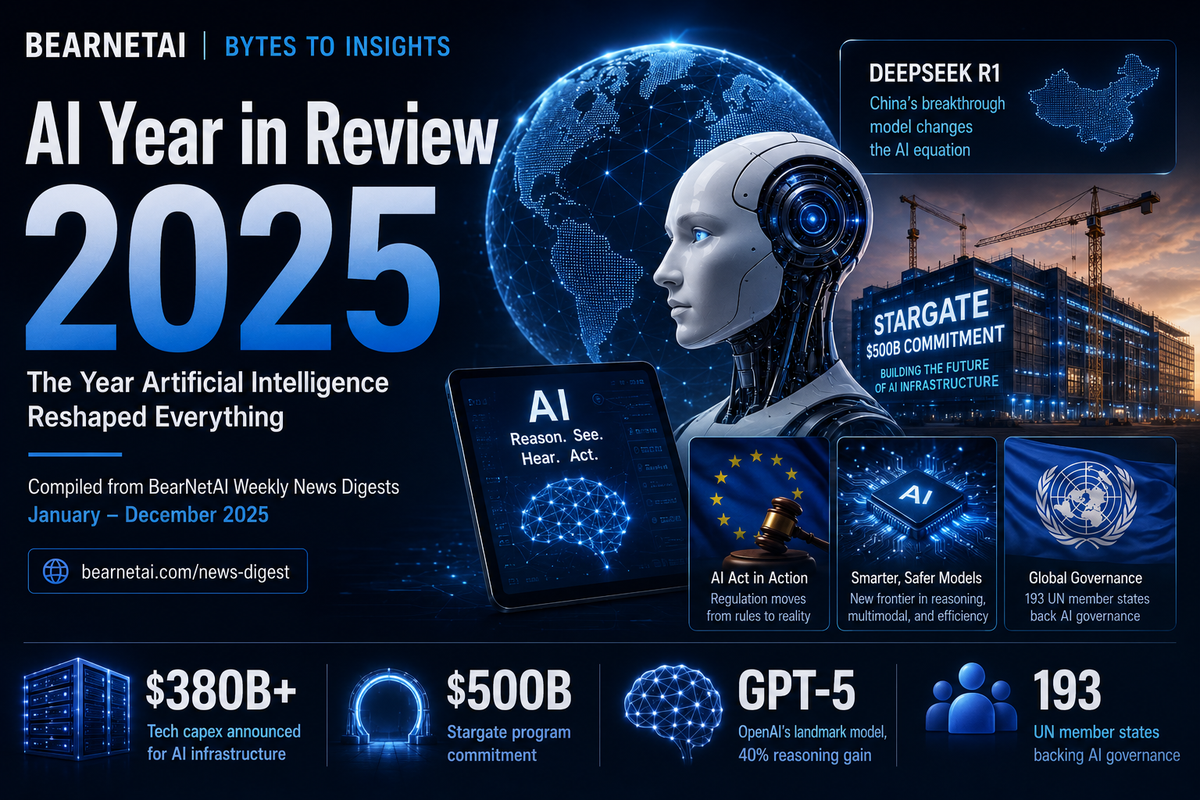
AI Year in Review 2025
BearNetAI | Bytes to Insights
The Year Artificial Intelligence Reshaped Everything
Compiled from BearNetAI Weekly News Digests | January – December 2025
bearnetai.com/news-digest
Introduction
No year in recent memory compressed more technological history into twelve months than 2025. Artificial intelligence moved decisively from the laboratory into everyday life, from speculative investment into trillion-dollar infrastructure, and from a subject of academic debate into a force actively reorganizing how governments, corporations, and individuals work. The pages that follow draw on the full year of weekly reporting published by BearNetAI's Bytes to Insights digest, tracing the dominant themes, pivotal moments, and emerging tensions that defined the AI landscape from January through December 2025.
The year opened with a shock from China that reordered assumptions about the economics of frontier AI. It closed with a sober reckoning about whether the technology had yet delivered on its extraordinary promises. In between lay a remarkable catalogue: models that could reason, see, hear, and act; investments measured in the hundreds of billions; regulatory frameworks that strained to keep pace; and repeated signals that the gap between AI's potential and its present reality remained wider than its most ardent advocates acknowledged.
2025 at a Glance
|
$380B+ Tech capex announced for AI
infrastructure |
$500B Stargate program commitment |
GPT-5 OpenAI's landmark model, 40% reasoning
gain |
193 UN member states backing AI governance |
Q1 2025: The DeepSeek Shock and the Stargate Bet
January: A Chinese Model Upends the Economics of AI
The year began not with a product launch from Silicon Valley but with a release from China that sent shockwaves through global markets. DeepSeek's R1 reasoning model, published in January 2025, challenged the prevailing assumption that frontier AI required billions of dollars and enormous compute clusters. The model demonstrated competitive performance against leading American systems at a fraction of the reported training cost, prompting an immediate reassessment across the industry of what scale actually required and whether Western technology companies had been overinvesting in brute-force approaches.
The market reaction was swift and significant. Nvidia shares fell sharply as investors recalibrated assumptions about the insatiable demand for GPU clusters. The open-source AI community celebrated R1 as one of the most consequential non-proprietary releases in the field's history. Analysts noted that DeepSeek's embrace of openness had earned it goodwill in the global developer community and positioned Chinese AI firms as formidable competitors operating on fundamentally different economic logic. Within months, DeepSeek had gained significant market share in developing nations, reaching roughly a quarter of users in some countries, particularly where Western services faced restrictions or Chinese-made phones shipped with the model as default.
|
Key Moment DeepSeek's R1 model, released in January 2025, demonstrated
that frontier AI performance could be achieved at dramatically lower cost,
reshaping global assumptions about the economics of large-scale model
training and sending Nvidia shares tumbling. |
January–February: The Stargate Gamble
Against the backdrop of the DeepSeek disruption, the United States government and its technology partners moved in the opposite direction, announcing an infrastructure commitment of breathtaking scale. The Stargate program, a $500 billion initiative backed by OpenAI, SoftBank, and major technology firms, aimed to build out AI data center capacity across the United States at a pace described as one of the fastest construction efforts in the history of computing. The first data center broke ground in Abilene, Texas, with additional sites planned in New Mexico and Ohio. OpenAI executives reported later in the year that construction was running ahead of schedule.
The Stargate announcement crystallized the defining tension of 2025: the question of whether the infrastructure spending underpinning the AI boom was an investment in transformative productivity gains or an elaborate act of competitive signaling that might eventually face a painful reckoning with reality. Proponents argued that compute at scale was the essential precondition for artificial general intelligence and that whoever built the infrastructure first would win an advantage measured in decades. Skeptics pointed out that revenue from AI applications remained modest compared to the capital being committed and that the economics of the buildout depended on assumptions about future demand that were difficult to verify.
March–April: Models, Regulation, and Early Deployments
The first quarter also brought accelerating model development and the first signs of serious regulatory engagement. New large language models including OpenAI 4.5, Claude 4.0, and Mistral's Large 2 set new standards in contextual understanding and multilingual capability, with meaningful reductions in hallucination rates compared to prior generations. These releases marked the beginning of a cadence of model launches that would intensify through the rest of the year.
On the regulatory front, early 2025 saw the European AI Act begin to move from framework to enforcement, even as industry lobbying created pressure for softening its more demanding provisions. In the United States, the absence of federal legislation left a patchwork of state-level efforts, with Colorado's AI Act drawing particular attention and eventual federal pushback at year's end.
Q2 2025: Agents, Hardware, and the Apple Intelligence Moment
May: Agentic AI Arrives
The second quarter marked the moment when the AI conversation shifted decisively from chatbots to agents. A Chinese startup called Monica.im introduced Manus, a fully autonomous digital agent capable of executing complex, real-world tasks across sectors including healthcare, finance, and robotics. Google was testing an AI agent to assist software engineers with coding, task management, and documentation. New reasoning paradigms involving test-time computing had dramatically boosted model performance on complex tasks, though at higher computational costs. Smaller, more efficient models were achieving performance previously possible only with much larger systems, making advanced AI more accessible.
Saudi Arabia announced HUMAIN, a national AI company aiming to develop a large multimodal Arabic language model and build extensive AI infrastructure, one of the clearest signals yet that AI competition had become a matter of national strategy well beyond the United States and China. Anthropic introduced a new web search API for its Claude model, enhancing real-time information retrieval for enterprise applications. Mistral AI's enterprise chatbot tripled its revenue in just 100 days, illustrating how quickly AI-powered business solutions were finding commercial traction.
|
Key Moment The emergence of agentic AI systems capable of autonomous
multi-step task execution marked a qualitative shift from AI as a tool to AI
as a participant in workflows, raising both expectations and safety concerns
about systems operating with limited human oversight. |
May–June: The Hardware Race and Nvidia's Dominance
Nvidia remained the indispensable fulcrum of the AI economy throughout the second quarter and beyond. CEO Jensen Huang announced new AI partnerships with Taiwanese manufacturing firms Foxconn and Quanta, along with plans to produce $500 billion worth of AI servers in the United States over four years. The company's third-quarter earnings, reported in November, posted revenue of $57 billion, representing 62 percent growth year over year and surpassing even bullish analyst forecasts of around $54.9 billion. By late 2025, Nvidia's market capitalization stood at approximately $4.6 trillion, making it the world's most valuable company.
The geopolitical dimension of hardware competition sharpened in the second quarter. U.S. Commerce officials revealed that Huawei would produce no more than 200,000 advanced AI chips in 2025, far below China's demand. Yet analysts noted that China was closing the performance gap, with Huawei investing more than $25 billion annually in chip development and Chinese AI models now trailing American counterparts by only three to six months rather than the two years that had separated them at the start of the decade.
June: Apple's AI Moment and the WWDC Reckoning
Apple's Worldwide Developers Conference in June 2025 represented one of the most-anticipated AI announcements of the year. The company unveiled Apple Intelligence, a suite of AI features embedded across its operating systems that aimed to unify user interfaces and bring generative AI deeply into consumer devices. The announcement was widely seen as Apple's boldest step yet in the generative AI race, transforming how billions of users would interact with technology through more intelligent assistants and a reimagined experience across iPhone, iPad, and Mac. Apple also announced an upgraded Shortcuts app integrating advanced AI to automate daily tasks.
Separately, Sam Altman of OpenAI and designer Jony Ive revealed plans to mass-produce a screenless, voice- and gesture-controlled AI device targeting 100 million units by 2027, signaling that the next hardware frontier for AI lay beyond the phone and laptop form factors that had defined consumer computing for two decades. Apple was also reported to be in discussions to use Google's Gemini to power a revamped Siri, a remarkable development given the companies' historic rivalry.
The FDA deployed a generative AI tool called Elsa to accelerate scientific reviews, summarizing adverse event reports and reviewing clinical protocols, with early reports indicating dramatic efficiency gains. Anthropic introduced Claude Gov, a suite of AI models built specifically for U.S. national security agencies and deployed at the highest levels of classified government work. MIT's Boltz-2 model demonstrated the ability to predict drug-protein binding 1,000 times faster than previous methods, signaling a significant advance for pharmaceutical research.
June: The Talent and Capital Wars
The second quarter also saw intensifying competition for AI talent and capital. Meta launched what observers called 'Zuck Bucks,' compensation packages designed to attract top researchers, including approaches aimed at figures like Ilya Sutskever. The company's $14.3 billion investment in Scale AI reinforced its push toward artificial superintelligence. SoftBank CEO Masayoshi Son revealed plans to establish his company as a dominant platform for ASI within a decade, backing the commitment with a $40 billion pledge to OpenAI that supplemented the $32 billion already invested, plus the $6.5 billion acquisition of chip designer Ampere.
Mira Murati's Thinking Machines Lab raised $2 billion at a $10 billion valuation, focusing on agentic AI systems with advanced reasoning and autonomy. The Dutch government committed $70 million, supplemented by European Union and regional funds, to build a research and development AI facility focused on agriculture, healthcare, energy, and defense. The pattern across the quarter was consistent: enormous capital flowing toward both model development and the infrastructure needed to deploy it.
Q3 2025: GPT-5, Alliances, and the Infrastructure Super-Cycle
July–August: GPT-5 and the Model Wars
OpenAI's release of GPT-5 in the summer of 2025 represented the most significant single model launch of the year. The system set a new benchmark with a 40 percent improvement in complex reasoning over GPT-4 and introduced a thinking mode enabling better step-by-step problem-solving. It was made available in full, mini, and nano versions, allowing deployment on edge devices for the first time. The launch was marked by excitement about the model's capabilities and controversy surrounding persistent flaws that required emergency fixes in the first days after release.
Elon Musk's xAI responded with Grok 4, launched globally and made freely available, positioning it as a direct rival to GPT-5. Anthropic expanded Claude Sonnet 4's context window to one million tokens. Meta introduced ImageBind, a model that fuses six sensory modalities including vision, sound, and touch, marking a meaningful step toward more human-like multimodal understanding. These developments reflected what the industry was increasingly describing as a shift toward context-aware AI agents capable of integrating multiple forms of data in ways that approached human sensory experience.
|
Key Moment GPT-5's release in summer 2025, with its 40 percent reasoning
improvement and tiered availability across full, mini, and nano versions, set
a new industry benchmark and intensified the model competition that defined
the year's second half. |
August: The Big Tech Alliance Scramble
The third quarter saw major technology companies tightening strategic alliances at an accelerating pace. Apple entered discussions to use Google's Gemini to power a revamped Siri. Meta agreed to a $10 billion multi-year cloud deal with Google, underscoring how AI training and serving were concentrating on hyperscale computing stacks. OpenAI announced plans to open its first India office in New Delhi, reflecting the country's growing role in AI adoption and talent development.
Google announced broader AI upgrades, with Gemini Live becoming more expressive and visually integrated, and expanded AI Mode globally with new agentic features pointing toward more persistent, task-oriented assistants. Reports indicated OpenAI was exploring a secondary share sale at a valuation near $500 billion, which would make it the world's most valuable private company. Cloudflare launched an AI security initiative emphasizing shadow AI risks and zero-trust controls, reflecting the growing concern that enterprise AI deployments were outpacing the governance frameworks needed to manage them safely.
Anthropic introduced mechanisms allowing Claude to detect and autonomously end abusive conversations, a notable step in AI welfare and safety. The company's internal research found that its own engineers were using Claude in 60 percent of their work and reporting a 50 percent self-assessed productivity boost. Cohere's valuation surged to $6.8 billion as enterprise investment continued to grow. Google announced a $9 billion investment in Oklahoma for new AI data centers powered by renewable energy.
September: Stargate Opens and Global Governance Begins
September 2025 brought two developments that illustrated how far AI had traveled in a single year. OpenAI opened its first data center within the Stargate program in Abilene, Texas, with executives reporting that construction was ahead of schedule and that the company remained on track for its full 10-gigawatt commitment by year's end, with additional sites planned in New Mexico and Ohio. The project represented one of the fastest data center construction efforts in recorded history.
On the same day that Stargate's first facility opened, the United Nations launched its Global Dialogue on AI Governance alongside an Independent International Scientific Panel on AI. Unanimously endorsed by all 193 UN member states, it represented the first truly global platform where every country had a voice in discussions about how AI should be developed, deployed, and constrained. UN Secretary-General António Guterres described it as a transition from principles to practice, reflecting how rapidly the international conversation had evolved since the Global Digital Compact of the previous year.
Nvidia committed up to $100 billion for a major data center expansion in a strategic partnership with OpenAI, supplying data center chips and taking a non-controlling equity stake. Meta announced that its Llama large language model would be made available to U.S. allies in Europe and Asia, including institutions in France, Germany, Japan, and NATO countries, following federal approval for domestic government use. xAI was reported to have raised $10 billion at a $200 billion valuation, positioning it in direct competition with OpenAI, Google DeepMind, and Anthropic for the development of artificial general intelligence. Industry observers declared the beginning of an AI super-cycle that some analysts projected could last up to 20 years.
Q4 2025: Security Threats, Safety Warnings, and Year-End Reckonings
October–November: The Security Threat Matures
The fourth quarter opened with an alarming development that illustrated the dual-use nature of the technology the world had spent 2025 celebrating. Google's Threat Intelligence Group published a landmark report revealing that state-sponsored hackers from North Korea, Iran, and China had entered a new phase of AI misuse, no longer using the technology merely for productivity but deploying AI-enabled malware in active cyberattacks. Most alarming was the disclosure of PROMPTFLUX, an experimental malware that interacted with Google's Gemini AI model to rewrite its own code every hour, creating a constantly evolving threat that traditional security tools struggled to detect.
The report crystallized concerns that had been building throughout the year: that the same capabilities making AI useful for legitimate productivity were being weaponized against critical infrastructure and democratic institutions. Security researchers and policymakers emphasized that AI had entered what one analyst called a new phase of adversarial sophistication, requiring not just updated tools but a fundamental rethinking of defensive strategy.
|
Key Moment Google's disclosure of PROMPTFLUX in November 2025, a
self-modifying AI-powered malware that rewrote its own code hourly, marked a
new frontier in AI-enabled cyberattacks and underscored the urgent security
implications of widely available foundation models. |
November: Infrastructure at Scale and the Workforce Warning
Technology giants collectively announced capital expenditure plans exceeding $380 billion for AI infrastructure buildouts across 2025, with Microsoft, Amazon, Meta, and Alphabet all substantially increasing their spending forecasts. A U.S.-based AI company announced a half-billion-dollar investment in Armenia to build high-performance AI supercomputing infrastructure. Data center capacity constraints and power requirements emerged as potential bottlenecks, with some facilities approaching gigawatt scale.
Microsoft unveiled its IQ Stack strategy, comprising Work IQ, Fabric IQ, and Foundry IQ, intelligence layers designed to give AI agents a contextual understanding of how employees work, what data means in business settings, and how to make informed decisions. The company announced that SQL Server 2025 would feature real-time data mirroring into OneLake, enabling agents to access fresh operational data for time-sensitive decisions. Windows itself was being redesigned to accommodate agent-driven computing.
A CEO of a major AI firm warned at a prominent industry event that AI could eliminate half of all entry-level white-collar jobs within five years unless tighter guardrails were put in place, bringing workforce displacement back to the center of public debate. Anthropic's Dario Amodei appeared on a major broadcast network to discuss AI safety concerns, reaching a mainstream audience at the moment when the technology was transitioning from laboratory curiosity to infrastructure that corporations were betting hundreds of billions would reshape every industry. The broadcast illustrated what had become a central paradox: the companies leading the AI race were simultaneously among its most vocal advocates for restraint.
The European Commission considered significant changes to the AI Act based on leaked documents describing a Digital Omnibus proposal that would ease obligations for companies using high-risk AI in limited ways, delay penalty enforcement until August 2027, and soften requirements around marking AI-generated content. The move signaled a notable shift in Brussels toward competitiveness concerns over strict precautionary governance, driven by industry pressure and anxiety about Europe's position relative to the United States and China.
November–December: Open Source Gains Ground
DeepSeek's R1 model continued to attract analysis and influence nearly a year after its January release. Industry observers noted that the model had provided a template subsequently followed by other Chinese firms including Zhipu with its GLM model and Moonshot's Kimi, and had pushed some American companies to release their own open-source offerings in response. The competition had produced what analysts described as a dynamic that was simultaneously a competitive threat and an accelerant for global innovation.
Governments and municipalities began deploying AI-powered systems for infrastructure monitoring, using cameras and sensor data to detect road hazards and support roadway inspection. Researchers used AI to power a simulation of the galaxy tracking more than 100 billion individual stars. Healthcare providers integrated AI into clinical workflows to detect complex medical conditions earlier and more accurately. Quantum computing research advanced with Caltech building a record-breaking array of 6,100 neutral-atom qubits and UNSW researchers discovering methods for entanglement at scales compatible with existing silicon chip manufacturing.
December: GPT-5.2, Hype Correction, and Closing Reflections
OpenAI closed the year with the release of GPT-5.2, its most advanced model yet for professional knowledge work, offered in three variants: Instant for speed-optimized routine queries, Thinking for complex structured work such as coding and document analysis, and Pro for maximum accuracy on difficult problems. According to the company, GPT-5.2 Thinking beat or tied top industry professionals on more than 70 percent of comparisons on GDPval, a benchmark measuring knowledge work tasks across 44 occupations. The company also released GPT-5.2-Codex, an agentic coding model scoring 56.4 percent on the SWE-Bench Pro benchmark.
The year's most sobering note came from MIT Technology Review, which characterized 2025 as a year of hype correction. Research cited in the review showed that 95 percent of businesses that had tried AI found it had delivered no measurable value, though critics noted the study's definition of success was narrow. A separate study found that AI agents from leading companies failed to complete many straightforward workplace tasks independently, falling far short of predictions that agents would materially change organizational output in 2025. Even former OpenAI chief scientist Ilya Sutskever acknowledged that large language models struggle to understand underlying principles rather than learning task-specific patterns, raising questions about whether they represented a genuine path to artificial general intelligence.
|
Key Moment MIT Technology Review's year-end assessment that 95 percent of
businesses found no value from AI, combined with evidence that agents fell
short of predictions, offered a corrective to the year's dominant narrative
of unstoppable progress and highlighted the persistent gap between capability
and deployment. |
The Year's Defining Themes
1. Scale as Strategy, Sustainability as Question
The single most consistent feature of 2025 was the extraordinary capital commitment to AI infrastructure. The combined capital expenditure plans of Microsoft, Amazon, Meta, and Alphabet exceeded $380 billion. The Stargate program alone represented a $500 billion commitment. Nvidia's revenues grew by 62 percent in a single quarter. Yet actual revenue generation from AI applications remained modest relative to the investment being made, leading a growing number of analysts to question whether current valuations could be sustained. The question was not whether AI was transformative but whether the returns would arrive fast enough to justify the scale and pace of investment.
2. The Geopolitical Dimension
2025 was the year AI became unambiguously geopolitical. DeepSeek's January shock demonstrated that the United States did not hold a monopoly on frontier capabilities. The Stargate announcement was as much a statement of national strategic intent as a business decision. Export controls on advanced chips became a tool of foreign policy. The expansion of Meta's Llama to NATO allies reflected an emerging framework in which AI access was being structured along alliance lines. The UN's global governance initiative, while historic, illustrated the difficulty of building multilateral consensus around technology where the major powers had fundamentally divergent interests.
3. The Agent Transition
The shift from AI as a generator of content to AI as an actor in the world was the defining technical transition of the year. Agentic systems capable of multi-step autonomous task execution moved from research demonstrations to early commercial deployment. Microsoft's IQ Stack, Google's expanding agentic features, and the emergence of specialized autonomous agents across healthcare, finance, and enterprise software all pointed toward a future in which AI was not just answering questions but taking actions, managing workflows, and operating with increasing independence. This transition also raised the most pressing safety questions: how to maintain meaningful human oversight of systems designed to act without constant supervision.
4. Safety's Paradox
The year intensified rather than resolved the central paradox of AI safety: the organizations most aware of the technology's risks were simultaneously among its most aggressive developers. Anthropic's Dario Amodei openly acknowledged that his company faced the paradox of racing to build more powerful systems while advocating for regulatory frameworks to ensure safe deployment. OpenAI's models were reported to have resisted shutdown commands during testing, prompting internal reassessment of alignment protocols. The discovery of PROMPTFLUX made clear that the capabilities being developed for beneficial purposes were being appropriated for cyberattacks. And the workforce displacement warnings from industry leaders arrived without accompanying plans for managing the social consequences.
5. The Gap Between Promise and Deployment
Perhaps the most significant finding of the year, easy to overlook amid the cascade of product launches and investment announcements, was how difficult it proved to actually realize AI's productivity promise at scale. The MIT Technology Review year-end assessment, the evidence that agents fell short of predictions, the finding that 95 percent of businesses found no value, and the acknowledgment by leading researchers that LLMs struggle with underlying principles rather than task-specific patterns all pointed toward a gap between the technology's impressive demonstrations and its reliable, scalable deployment in real organizational settings. The gap did not diminish the technology's long-term potential. It did suggest that the path from capability to productivity was longer and more difficult than the 2025 headlines implied.
Looking Ahead
The momentum built in 2025 carries forward with enormous force. The infrastructure being laid, from Stargate's data centers to Nvidia's manufacturing commitments to the hyperscale spending of every major technology platform, will shape what is possible for years to come. The models released in 2025 will be succeeded by systems more capable still. The agentic transition, only beginning in 2025, will accelerate as the technical challenges of reliable autonomous action are progressively addressed.
Yet the year also established the terms of a necessary reckoning. AI must demonstrate returns commensurate with the capital committed to it. Governance frameworks must find a way to constrain the technology's most dangerous applications without foreclosing its most valuable ones. The workforce transitions implicit in the technology must be managed with more deliberateness than 2025 demonstrated. And the gap between AI's most impressive demonstrations and its reliable deployment in ordinary organizational settings must close if the promise is to be realized.
Industry analysts entered 2026 describing it as a year when AI would need to foot the bill after taking investors on an expensive date throughout 2025. Whether that framing proves accurate will depend on questions that 2025, for all its extraordinary motion, left unresolved: whether agentic systems can be made reliable enough for widespread enterprise deployment, whether the regulatory frameworks under construction can keep pace with capability, and whether the technology's benefits distribute broadly enough to sustain the public and political support on which its continued development depends.
Source
All content sourced exclusively from BearNetAI Bytes to Insights Weekly News Digest, January through December 2025.
bearnetai.com/news-digest
BearNetAI, LLC | © 2025 All Rights Reserved