A BearNetAI Viewpoint: AI and Tech Authoritarianism
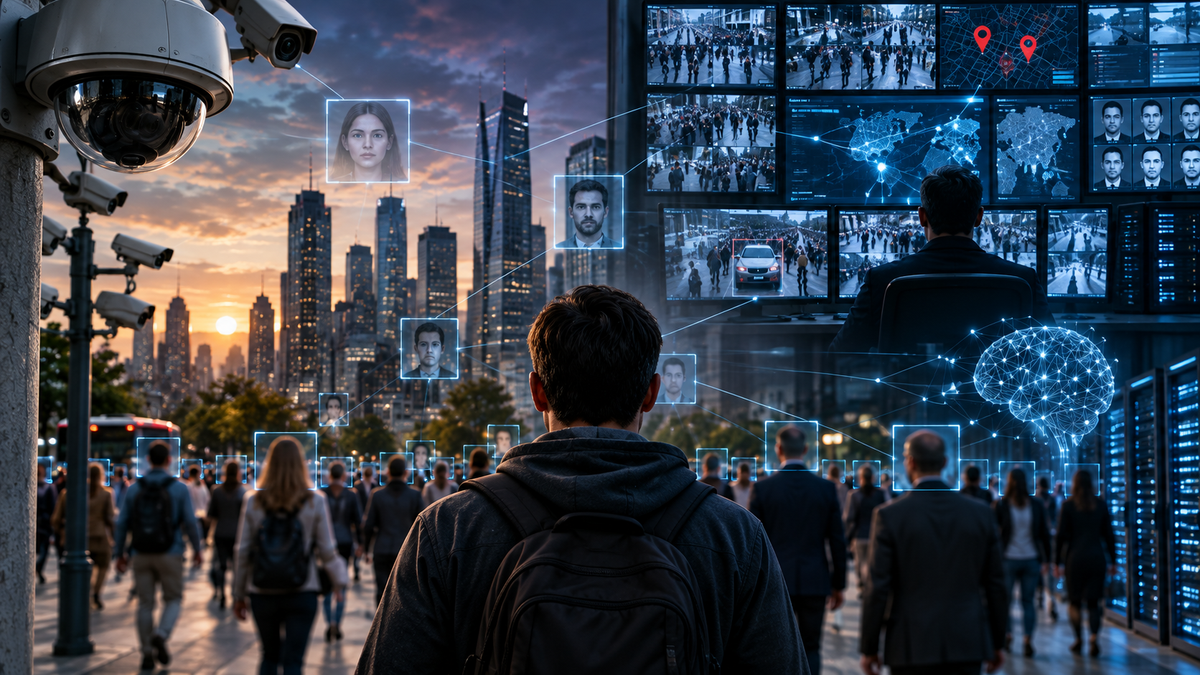
Tech authoritarianism is a useful name for a political and social arrangement in which digital tools give a government, sometimes acting alone and sometimes working alongside powerful private companies, an extraordinary ability to observe, sort, influence, restrict, and ultimately control the people it governs. The phrase means something more specific than a dictatorship that happens to own computers. The idea worth holding onto is that technology can make authoritarian control cheaper, quieter, easier to scale, and far less visible than the older forms of repression ever were.
A government that wanted to keep watch over its population in the past had to hire people to do it. It needed police officers, paid informants, censorship offices, filing clerks, checkpoints, and the bureaucracies that held it all together. Those methods cost real money and produced imperfect results. Files went missing. Informants lied or invented what they could not learn. Watching one group closely meant leaving another group alone. The expense and the clumsiness were never intended as protections for anyone. Still, in practice they functioned something like protections, because they placed a natural ceiling on how much a state could actually know.
That ceiling is disappearing. Picture a government with routine access to location histories drawn from mobile phones, camera networks running facial recognition, records of financial transactions, license plate readers logging the movement of vehicles, communications metadata, internet search activity, maps of who knows whom, biometric databases, and AI systems capable enough to read all of it together.
The decisive change isn't the volume of information, since much of it has existed for years. The change is that a human being no longer has to sit down and go through it. Software can move across enormous archives and answer questions in minutes that once would have occupied an investigative team for months. Who attended that demonstration? Who talks regularly with the people who attended a given location? Whose travel patterns shifted in the days and weeks afterward? Who publishes criticism of the current government? Who sent money to which organization? Who, on the strength of all of that, deserves a closer look? Once a system can answer questions like those without human effort, surveillance quietly becomes something closer to automated governance.
It matters that none of these technologies is authoritarian by nature. Facial recognition helps locate a missing child. License plate readers recover stolen vehicles. AI catches fraud that no auditor would ever find by hand. Cameras supply evidence after a crime that would otherwise go unsolved. Digital identity systems can make ordinary dealings with government faster and less humiliating for the people who need them most. Any honest discussion of surveillance has to begin by admitting that these capabilities do real good.
The danger shows up when several conditions converge. Data gets collected in bulk. Legal constraints stay weak or deliberately vague. Political power concentrates in fewer hands. Decisions become automated. Transparency thins out. Judicial oversight turns into a formality. Any one of those conditions is manageable on its own. Together they change what government fundamentally is. Technology stops helping the state administer a society and starts giving the state the ability to evaluate that society continuously, person by person, without ever having to explain itself.
One feature of these systems is easy to overlook because it leaves no record anywhere. Nobody has to be arrested for the arrangement to work. If people come to believe that anything they do might eventually be reviewed, they begin adjusting on their own. They skip the protest. They think twice about the book, the donation, the meeting, the website, the argument they might otherwise have made out loud. Political theorists call this a chilling effect, which is a mild phrase for something that reshapes a civic culture from the inside.
The efficient surveillance state, then, is not the one that punishes everyone. It is the one where punishment becomes largely unnecessary, because the population has learned to watch itself.
This is the reason I keep returning to AI in conversations about civil liberties. For decades, societies piled up digital information far faster than anyone could examine it. The bottleneck was attention. There were never enough investigators and never enough hours, and that shortage probably did more to protect ordinary privacy than most laws did.
AI removes much of that bottleneck. A government may eventually be able to pose a request like this. Identify the people whose behavior over the past six months suggests growing hostility toward the administration. That is not the same thing as searching a database for a suspect already known to have committed a crime. It shifts the enterprise from investigating what someone did to predicting what someone might become.
Prediction has its own failure mode: the false positive. A person can land under suspicion having done nothing at all, simply because a model decided their pattern of behavior resembled the pattern of people the system was trained to flag. Explaining your way out of that position is remarkably difficult, partly because the accusation is statistical rather than factual, and partly because nobody involved may be able to say precisely why the system chose you.
A second dimension often goes missing from these discussions. A government does not have to build the surveillance apparatus itself. Much of it already exists, assembled for commercial reasons by companies with no political agenda whatsoever. Smartphones, advertising networks, connected vehicles, smart home devices, social platforms, payment processors, location services, and data brokers together hold a portrait of daily life more detailed than any intelligence service of the last century could have hoped to assemble.
What matters is how easily that material can cross the boundary between commerce and the state. When a government can buy the data outright, subpoena it, demand it under emergency authority, or obtain it through a partnership that never becomes public, the distinction between corporate surveillance and government surveillance stops being meaningful in any practical sense.
A society can construct nearly all of the infrastructure required for authoritarian control while remaining, at that moment, a functioning democracy. The political transformation, if it arrives, arrives later, and it does not need to build anything new. It only needs to inherit what is already running. That is the strongest argument I know for putting safeguards in place well before anyone can point to an emergency that makes them feel urgent.
History rarely provides a clean announcement. No country wakes up one morning and declares that the authoritarian system has been installed. Institutions weaken gradually, and each step arrives with a justification that sounds reasonable on its own terms. Terrorism. Violent crime. Immigration enforcement. Fraud. Public safety. National security. Misinformation. Cybersecurity. Some of those concerns are entirely legitimate, which is exactly what makes the pattern so hard to argue against one measure at a time.
So the question cannot only be whether there is a good reason for a particular technology. There almost always is. The harder question is what a future government could do with the same infrastructure if the people running it were not trustworthy. Very few proposals survive that test intact.
In the United States, all of this runs straight into the First and Fourth Amendments, along with due process, equal protection, the separation of powers, federalism, and judicial review. The Fourth Amendment in particular was written by people reacting to general searches, to the idea that authority could rummage through a person’s life without first stating what it was looking for and why.
The founders could not have imagined smartphones, cloud databases, facial recognition, or machine learning. The underlying problem, though, would have been immediately familiar to them. How much can a government learn about an individual before it has to demonstrate a specific reason for wanting to know? Modern technology makes that question far harder, because searching someone no longer requires entering their home. A person’s digital record reveals patterns of belief, association, health, movement, and habit that an eighteenth-century magistrate could not have extracted from a house search conducted over a week.
I keep a progression in mind. Surveillance leads to identification, identification to classification, classification to prediction, prediction to restriction, and restriction to punishment. A healthy democracy can legitimately use the early parts of that chain under the right circumstances and with real oversight. The danger lies in allowing the whole chain to end to end, automatically, under political control, with no point along the way where a human being has to justify the next step to someone empowered to say no.
When a new surveillance power is proposed, one question cuts through most of the noise surrounding it. Would you still support giving government this capability if the political leader you trust least held it starting tomorrow? If the answer shifts depending on who occupies the White House, the governor’s office, or the local police department, then the safeguards attached to the proposal are not strong enough. Rights that depend on the good character of whoever currently holds office are not rights at all. They are courtesies.
These questions connect closely to work I have been doing on AI, self-surveillance, warrants, constitutional protection, and the reach of state power. Tech authoritarianism may be the most consequential place where AI and democracy meet over the next decade, and many of the decisions that determine how it goes are being made right now, quietly, in procurement contracts and platform terms of service rather than in any debate the public gets to watch.
This has been a BearNetAI Viewpoint.
Thank you for being a part of this fascinating journey.
BearNetAI. From Bytes to Insights. AI Simplified.
BearNetAI is a proud member of the Association for the Advancement of Artificial Intelligence (AAAI), and a signatory to the Asilomar AI Principles, committed to the responsible and ethical development of artificial intelligence.
Support BearNetAI
BearNetAI exists to make AI understandable and accessible. Aside from occasional book sales, I receive no other income from this work. I’ve chosen to keep BearNetAI ad-free so we can stay independent and focused on providing thoughtful, unbiased content.
Your support helps cover website costs, content creation, and outreach. If you can’t donate right now, that’s okay. Sharing this post with your network is just as helpful.
Thank you for being part of the BearNetAI community.
Marty Crean
BearNetAI, LLC | ©2026 All Rights Reserved
Books by the Author:
Short Essays on Artificial Intelligence - Vol 1
Short Essays on Artificial Intelligence - Vol 2
Your Child is Already Using AI
🌐 BearNetAI: https://www.bearnetai.com/
💼 LinkedIn Group: https://www.linkedin.com/groups/14418309/
🦋 BlueSky: https://bsky.app/profile/bearnetai.bsky.social
📧 Email: marty@bearnetai.com
👥 Reddit: https://www.reddit.com/r/BearNetAI/
🔹 Signal: bearnetai.28
This post is also available as a podcast if you prefer to listen on the go or enjoy an audio format: