AI and the Vanishing Middle Class - How Artificial Intelligence Is Reshaping Economic Security
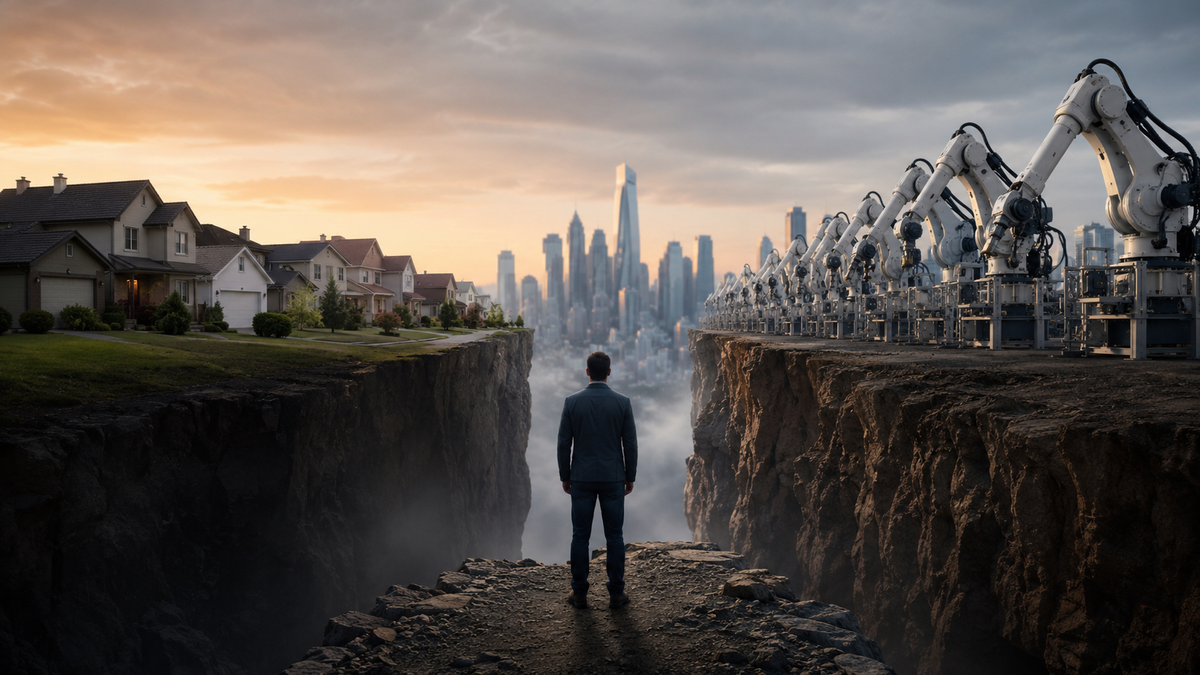
AI is often hailed as a force that will raise productivity, ease work, advance science, and promote prosperity, much like electricity, automobiles, and the internet, reshaping the economy and improving most lives.
Yet beneath this optimism lies a growing concern, particularly among accountants, analysts, marketers, developers, project managers, teachers, financial professionals, and technical writers, those traditionally considered part of the middle class, not just factory workers or tech executives.
This worry might seem like a simple fear of change, but history offers plenty of reassurance. New technologies have disrupted one industry after another, and, in the end, created more opportunities than they destroyed. The mechanization of farming reduced the number of farmers and helped spur modern manufacturing. The computer eliminated many clerical roles and gave rise to entirely new industries. By that logic, AI is simply the next turn of a familiar wheel.
Yet today's anxiety deserves a closer look because the timing is what sets it apart. Artificial intelligence is arriving at a moment when the middle class is already losing ground. Housing has grown more expensive, education costs more, wages have stalled for many workers, and wealth has gathered steadily at the top. While AI did not cause these shifts, it may speed them along in ways that prove difficult to reverse.
The real question is not whether AI will change the nature of work, because it already is. The question is whether the gains from that change will be shared widely or captured by a small number of companies and the people who own them.
To understand how AI might affect the middle class, it helps to be clear about what the term really means. Economists usually describe it in terms of income ranges, which is useful for statistical work but misses something essential. For most people, the middle class is not a number on a tax return. It is a promise.
The promise is that if you work hard, build skills, act responsibly, and contribute to the people around you, you can earn a reasonable measure of security in return. You can buy a home, raise a family, set something aside for retirement, and trust that your children will have opportunities at least as good as your own. The whole arrangement rests on predictability. People make long-term decisions about mortgages, degrees, and careers on the assumption that their skills will remain valuable and their effort will continue to produce stable rewards.
This is why the worry about AI runs deeper than the fear of losing a single job. What people sense is the possibility of losing confidence in the promise itself. If entire categories of skilled professional work become unstable or quickly lose their value, the problem extends well beyond employment figures. It touches on the idea of social mobility that gives the middle class its meaning.
One of the most common mistakes in discussions about AI is the assumption that today's pressures began with large language models. In truth, the hollowing out of the middle class has been underway for decades. Economists have a name for the pattern they have tracked across that period. They call it labor market polarization.
Over the years, a mix of automation, software, global trade, and faster communication steadily reduced the demand for routine middle-skill work. Manufacturing jobs that once supported whole families disappeared through automation or moved overseas. Clerical positions thinned out as software took over the routine paperwork that once filled an office. At the same time, demand grew at both ends of the spectrum. Highly skilled professionals who could design, manage, or build on top of technology became more valuable than ever, while many hands-on service jobs that require physical presence, such as home health aides, food service workers, and maintenance staff, stayed stubbornly hard to automate.
The result was a labor market shaped like a barbell, with growth at the top and the bottom and a slow erosion in the middle. For years, the standard advice in response was consistent and clear. Get more education, build more advanced skills, and move into knowledge work. For a great many people, that advice worked. The difficulty now is that those same knowledge professions are among the first to be transformed by generative AI.
Every major technological revolution has produced warnings of mass unemployment, and most of those warnings proved too gloomy. What makes AI different is not only how capable it is, but the kind of work it does. Earlier automation was good at repetitive physical tasks and structured paperwork. Machines could assemble products, sort inventory, and process routine forms, while human thinking stayed largely out of reach. Creativity, analysis, communication, judgment, and problem-solving were treated as distinctly human strengths, and those strengths became the foundation of modern middle-class employment.
You can see how much depended on them. Law firms hired junior associates to do research. Marketing departments built teams of writers. Banks leaned on analysts, software companies on programmers, and consulting firms on graduates who gathered information, prepared reports, and supported the people making decisions. Generative AI now does parts of all of this. It can draft documents, summarize reports, write code, analyze data, produce marketing copies, answer customer questions, and generate visual designs.
The important point is that AI does not have to replace an entire job to reshape a labor market. If a tool lets one worker handle what used to take three workers, the demand for that kind of labor changes sharply, even though people are still in the loop. That is the source of the unease so many professionals feel. The credentials and specialized skills that once served as protection may no longer work as barriers, and the ladder workers were told to climb may be changing shape beneath their feet.
Any honest account of AI must take its strongest defense seriously, and that defense rests on a great deal of evidence. Technological progress has, over the long run, raised living standards again. The Industrial Revolution caused enormous upheaval and still produced unprecedented growth. Electricity remade entire industries and created new ones. Personal computers eliminated some jobs while creating millions of others. Seen this way, AI looks like another chapter in a story we already know.
Optimists argue that AI will augment workers more than it replaces them. Doctors may reach more accurate diagnoses, teachers may tailor instruction to individual students, engineers may solve problems faster, and small businesses may gain abilities that once required a large staff. Productivity could rise, costs could fall, and services could improve across the board. New industries may appear that are hard to picture today, much as the internet gave us social media managers, app developers, and cybersecurity analysts who had no equivalent a generation ago.
There is also a great deal of work that draws on human qualities that machines still struggle to match. Trust, empathy, leadership, negotiation, relationship-building, and context-dependent judgment all remain deeply valuable. Through this lens, AI looks less like a threat and more like a powerful tool that expands what people can do. That view should not be dismissed, and it may well prove right.
The real difficulty is not simply whether AI can create new opportunities. It almost certainly can. The core argument is whether those opportunities arrive quickly enough, broadly enough, and in sufficient numbers to sustain the middle class, not just in the long run but through the challenging transition. The long-run benefits of technology often hide the short-run costs. Economists noted that earlier revolutions eventually produced more jobs than they destroyed. These transitions can span years or decades, and people living through displacement do not fit within economic models. They live inside mortgages, tuition bills, medical costs, and retirement accounts.
A college graduate of twenty-five may have the time to retrain and adapt. A forty-five-year-old analyst supporting a family is facing a very different calculation, and even when new opportunities do appear, they may call for different skills, a different city, or different pay. The timing of the change matters as much as the eventual outcome.
There is a second concern, and it has to do with ownership. Earlier industrial transformations spread their gains through a combination of strong labor demand, new businesses, and wide participation in a growing economy. AI may distribute value along very different lines. Building advanced systems takes enormous computing power, vast amounts of data, rare expertise, and heavy capital investment, which tends to concentrate ownership among a relatively small set of technology firms and investors. If the productivity gains flow mainly to the owners of that capital rather than to workers, then growth by itself will not necessarily strengthen the middle class. The economy could grow richer even as a large share of the population feels less secure.
Ownership has always shaped how the rewards of new technology are shared. The Industrial Revolution generated immense wealth, but none of it was distributed automatically. Labor protections, collective bargaining, public education, investment in infrastructure, and social safety nets all emerged, in part, as responses to industrial concentration. AI may present a similar test. A handful of organizations already control many of the most advanced models, along with the cloud infrastructure and computing capacity that support them, and as those systems spread through the economy, their owners may capture a growing share of the value they create. Because AI performs cognitive work rather than only physical work, that pressure could fall on the very professions that once offered the most stability. The outcome is not inevitable, but it is plausible, and it is what makes this moment genuinely different from many of the technological shifts that came before.
It is tempting to treat technological change as an unstoppable force that simply dictates social outcomes, but history suggests otherwise. Technology shapes a society, yet institutions decide how that shaping is felt. The rise of industrial manufacturing did not automatically deliver either broad prosperity or widespread exploitation. Different countries made different choices and arrived at different results. The same will hold for AI.
Whether AI strengthens or weakens the middle class depends heavily on decisions made by governments, businesses, schools, and ordinary citizens. Tax structures, workforce programs, education design, competition policy, labor protections, and the rules governing who owns this technology will all play a part. A society can choose to invest in helping workers adapt, to widen participation in the gains, to reshape education around skills that complement AI rather than compete with it, and to encourage new businesses while protecting the chance to move up. Or it can let the existing drift toward concentration and inequality run faster. Technology does not make that decision. People do.
AI is best understood not as destiny but as an accelerant. It magnifies whatever economic structures are already in place. Where those structures are healthy and inclusive, AI may broaden prosperity. Where they are already producing instability and concentration, AI is likely to deepen both.
Conversations about artificial intelligence tend to settle on employment numbers, productivity figures, and economic forecasts. Those measures matter, but they do not capture the whole of what is at risk. A vanishing middle class is not only an economic event. It is a social one.
The middle class has long acted as a stabilizing force in democratic societies. It provides a broad base of people who believe their effort counts, their future is reasonably secure, and their children can build something better. When that belief weakens, trust tends to follow. Confidence in institutions declines, social cohesion grows more fragile, political divisions often sharpen, and people begin to ask whether the system still works for them at all.
Artificial intelligence will not decide the future of the middle class on its own, nor will it single-handedly destroy economic opportunity. But it arrives at a moment when many of the assumptions that have supported middle-class life are already under strain. That is why the real challenge is not, at heart, a technological one. It is political, economic, and cultural. The future will not be settled by what AI can do, but by what societies decide to do with it.
That distinction is the hopeful part, because it means the outcome is still open. The disappearance of the middle class is not a prediction. It is a possibility. Whether it becomes real depends far less on the machines we build than on the choices we make.
Marty Crean
BearNetAI, LLC | ©2026 All Rights Reserved
🌐 BearNetAI: https://www.bearnetai.com/
💼 LinkedIn Group: https://www.linkedin.com/groups/14418309/
🦋 BlueSky: https://bsky.app/profile/bearnetai.bsky.social
📧 Email: marty@bearnetai.com
👥 Reddit: https://www.reddit.com/r/BearNetAI/
🔹 Signal: bearnetai.28
Support BearNetAI
BearNetAI exists to make AI understandable and accessible. Aside from occasional book sales, I receive no other income from this work. I’ve chosen to keep BearNetAI ad-free so we can stay independent and focused on providing thoughtful, unbiased content.
Your support helps cover website costs, content creation, and outreach. If you can’t donate right now, that’s okay. Sharing this post with your network is just as helpful.
Thank you for being part of the BearNetAI community.
Books by the Author:
This post is also available as a podcast: