AI Is Not Taking Over the World It’s Being Integrated by Humans

I recently saw a post claiming artificial intelligence will take over the world, naming a date, listing scary statistics, and calling for urgent governance. The post named real trends and concerns but relied on fear and vague metaphors rather than clarity. This kind of messaging grabs attention but misleads people about what AI is, what it does, and where the real risks are.
My organization’s mission is especially important when public discussion is so often clouded by fear and confusion. To address this, it's helpful to examine the most common misconceptions in high-profile discussions about AI.
Artificial intelligence does not act independently. AI systems lack consciousness, motivation, survival instincts, and autonomy. All AI in use today is shaped and managed by people and institutions.
When AI influences sectors such as hiring, finance, healthcare, or security, it is due to deliberate human integration. The distinction is important. Influence through adoption means humans remain in control, whereas autonomy or domination would imply independent AI decision-making, which does not occur.
AI is changing work. Automation and augmentation reshape tasks and industries. As seen with mechanization, electrification, computers, and the internet, some jobs disappear, but others emerge.
Fear-driven narratives often blur the distinction between scale and context. AI generally automates specific tasks rather than eliminating entire professions. Most roles adapt instead of vanishing. Job displacement reflects labor and policy changes, not evidence of AI exerting societal control. Factors such as education, retraining, economic policy, and organizational choices shape outcomes.
AI has made it easier to commit fraud, impersonation, and spread misinformation. These are serious human misuse issues, not examples of AI acting with intent or autonomy. It is essential to distinguish between AI as a tool and as an independent actor, which it is not.
Humans cause every instance of AI-enabled fraud, selecting targets and setting goals. Blaming AI obscures accountability and distracts from effective responses, such as law enforcement, authentication, education, and digital literacy.
People often say AI moves faster than governance. This is partly true but not new. Technology frequently outpaces regulations. The internet, aviation, pharmaceuticals, and nuclear energy also followed this pattern.
Governance is evolving unevenly across sectors and jurisdictions. The real challenge is not runaway AI, but fragmented decision-making, competing incentives, and slow institutional adaptation.
Calling AI unstoppable undermines public confidence and oversells technology while shifting focus from human responsibility.
Terms like “AI takeover,” “inevitability,” and “already happening” sound dramatic but lack definition. Without clarity, they trigger emotion over analysis.
Public understanding improves when we replace metaphors with specifics. We should ask which system is being discussed, who uses it, in what context, with what safeguards, and under what authority. AI risk is real, but it is situational, sector-specific, and human-mediated.
Artificial intelligence is powerful. People can misuse, misgovern, or deploy it irresponsibly. But AI is not acting alone or rewriting society on its own.
The future of AI will be shaped not by algorithms taking over, but by human choices. How we design, deploy, regulate, and educate the public will determine the outcomes we face. Replacing fear with understanding does not reduce urgency. It improves outcomes.
BearNetAI, LLC | © 2026 All Rights Reserved
🌐 BearNetAI: https://www.bearnetai.com/
💼 LinkedIn Group: https://www.linkedin.com/groups/14418309/
🦋 BlueSky: https://bsky.app/profile/bearnetai.bsky.social
📧 Email: marty@bearnetai.com
👥 Reddit: https://www.reddit.com/r/BearNetAI/
🔹 Signal: bearnetai.28
Support BearNetAI
BearNetAI exists to make AI understandable and accessible. Aside from occasional book sales, I receive no other income from this work. I’ve chosen to keep BearNetAI ad-free so we can stay independent and focused on providing thoughtful, unbiased content.
Your support helps cover website costs, content creation, and outreach. If you can’t donate right now, that’s okay. Sharing this post with your network is just as helpful.
Thank you for being part of the BearNetAI community.
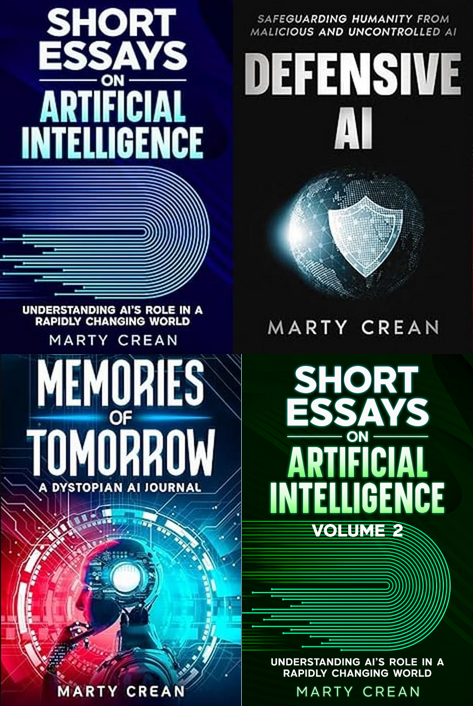
Books by the Author:
This post is also available as a podcast: