Can AI Make Society More Human, or Less?
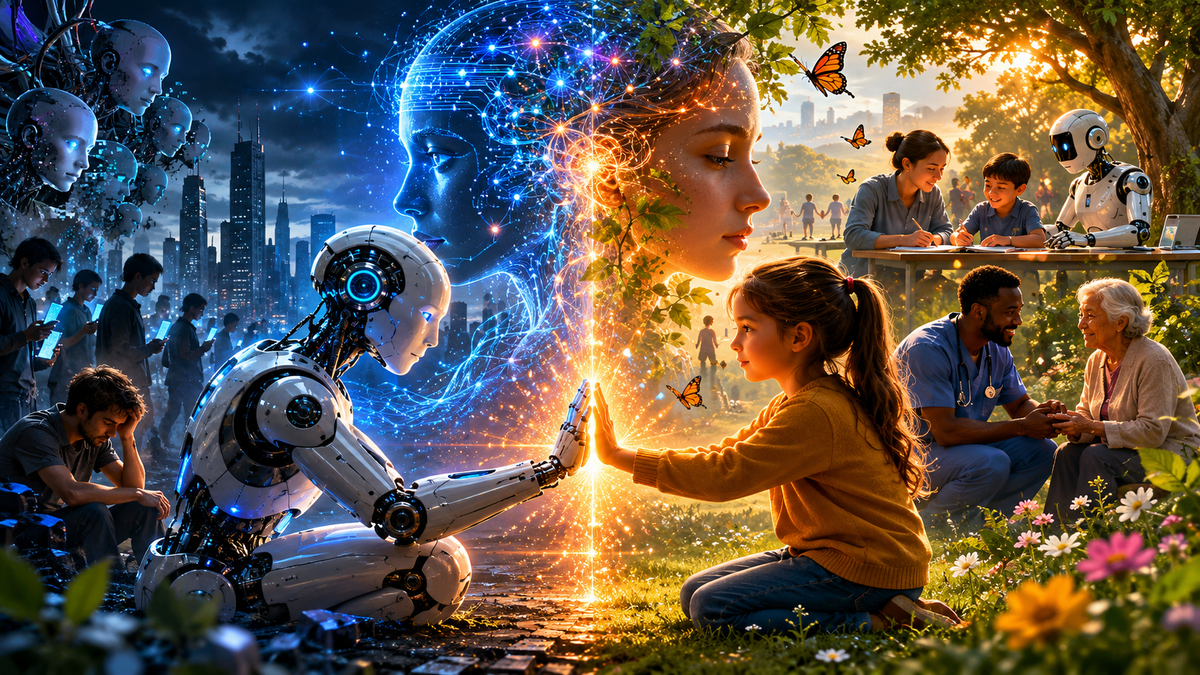
Artificial intelligence now drafts emails, summarizes meetings, makes images, answers questions, translates languages, and performs work once reserved for people. Most public conversation about AI focuses on productivity, jobs, and innovation. However, the essential question is often overlooked: Is AI making us more human, or less? This question reframes the debate away from utility toward the core of our humanity.
Two short scenes might help frame what is at stake.
A grieving son sits to write a eulogy for his father but cannot begin. He turns to an AI assistant, shares memories, receives help organizing his thoughts, and eventually writes something that captures emotions once out of reach. Technology bridges feeling and language; the result is undeniably his.
In another scene, someone receives a condolence message after losing a loved one. The note is graceful and well-crafted. Later, by chance, they learn AI wrote almost all of it with little input from the sender. The same words that once felt caring now feel hollow.
Technology performs the same function in both scenarios, yet the outcomes are starkly different. In one, AI aids a deeply personal process, strengthening connection to self; in the other, it replaces genuine interaction, making the gesture feel empty. The contrast reveals how use and intent can transform the impact of the same tool.
Debates about AI often focus on whether it is good or bad, helpful or harmful. Yet the critical question is not merely what AI does for us, but what it does to us as humans. Will it strengthen qualities like creativity, compassion, and connection, or will it erode the traits that define humanity? Answering this shapes not just technological futures but the trajectory of who we become.
Before deciding whether AI makes us more or less human, we need a working sense of what being human means in the first place.
For some, humanity lives in creativity, in the ability to imagine and make things that did not exist before. For others, it is found in relationships, in empathy, sacrifice, and love. Some point to our capacity for meaning, making our willingness to endure hardship, and our search for purpose in the face of uncertainty. Still others emphasize embodiment, mortality, and the limits that give shape to a life. Humanity is not a single thing. It is a layered set of traits, behaviors, values, and experiences that together describe a way of being in the world.
History also asks us to be careful before declaring any new technology either liberating or destructive. Socrates worried that writing would weaken memory, since people would no longer carry knowledge inside themselves but would lean on the page. In a sense, he was right. Writing did change how we remember. It also opened up forms of thought that human memory alone could not sustain. Every later communications revolution prompted similar fears. The printing press, radio, television, and the internet each produced anxieties about what might be lost, and every generation worried that something essential was disappearing.
AI introduces a fundamentally new dynamic. Unlike previous technologies, which conveyed human expression, books transmitting authors’ thoughts, broadcasts relaying producers’ work, websites reflecting designers’ choices, AI generates text, images, music, and conversation from a source that is neither fully human nor fully machine. This blurring of origin is central to understanding AI's impact. To assess it, we must weigh both its promise and its risks for our humanity.
The strongest argument in favor of AI is not that it makes people more efficient. It is that it might free people to spend more time on what matters to them.
Technology has often relieved us of work that consumed energy without producing much meaning. Washing machines reclaimed hours from households. Agricultural machinery reduced backbreaking labor in the fields. Computers absorbed countless repetitive tasks. AI may do something similar for cognitive labor. Scheduling, organizing files, summarizing long documents, drafting routine messages, and managing the small administrative debris of modern life that consume an enormous amount of mental energy. If AI handles even a portion of that load, the result could be more attention available for relationships, creativity, learning, and rest.
Many writers, artists, and entrepreneurs use AI as a thinking partner, not a substitute. Novelists use it to get past stuck passages. Painters sketch concepts with it. Founders test ideas with a fast interlocutor. Used this way, AI amplifies human imagination rather than replacing it.
AI can expand access to expertise once reserved for the wealthy. A child without a private tutor can get patient explanations. Someone navigating legal complexity can gain understanding without paying for hours of consultation. People far from specialists can get reasonable answers that would otherwise remain out of reach.
Accessibility is a clear area where AI already improves lives. Real-time captions help people who are deaf or hard of hearing follow conversations. Image description tools assist those who are blind or have low vision. Communication aids give a voice to those rarely heard. This does not replace humanity; it expands participation in it.
The same principle could reshape professional life if we let it. Picture a physician who spends less time entering notes and more time talking with patients. Picture teachers who grade less and mentor more. Picture social workers who have time for the families they are supposed to help because paperwork no longer eats up their days. These outcomes are not guaranteed. Institutions can just as easily use AI to push workloads higher rather than to give workers their attention back. But the possibility is real, and it is worth fighting for.
Even AI companionship, which provokes uneasy reactions, deserves a careful hearing. Loneliness is widespread and painful. For some people, especially older adults living alone or enduring long stretches of isolation, a responsive conversational system can offer something that is not quite friendship but still valuable. It is no substitute for human connection. For someone facing silence, however, it may still be better than silence.
Through this lens, AI appears not just as a tool, but as a technology capable of amplifying core human experiences, creativity, connection, and participation when used intentionally.
The opposing argument raises crucial concerns, often subtle but profound. If AI shifts how we think, relate, and create, we must ask whether these changes ultimately undermine the human capacities and connections at the heart of our lives.
The first concern is cognitive atrophy. Writing is not only a way of communicating but also a way of thinking. The act of arranging ideas, building an argument, and choosing the right word does something to the mind that no shortcut can quite replicate. When AI takes over that work, what happens to the thinking that the work used to produce? The same question follows us into reading, summarizing, problem-solving, decision-making, and remembering. Mental capacities develop through use, and capacities that go unused tend to weaken. Convenience comes with hidden costs, and the costs are easy to miss because they show up slowly and in the parts of ourselves, we rarely measure.
There is also the question of mastery. Great musicians, surgeons, writers, and engineers rarely arrive fully formed. Expertise grows out of years of practice, mistakes, repetition, and gradual refinement. If AI does much of the work that once trained the apprentice, where do the next masters come from? Perhaps we will discover new pathways to mastery. We may also hollow out the journey, leaving fewer people who have walked it.
This concern involves both relationships and skills. Human relationships, with their misunderstandings and vulnerabilities, demand real effort and change us in ways friction-free AI companions cannot. While AI friends offer comfort and convenience, they present a contrast. Their lack of needs and challenges means they cannot replicate the depth or growth found in true human connection.
Authenticity also highlights a crucial contrast. When nearly any expression, text, image, voice, or video can be generated by AI, the distinction between what is genuine and what is artificial takes on new weight. Traditional expressions draw meaning from human effort and emotion. As AI-generated content spreads, the risk is that we lose clarity about which expressions arise from sincere human intention and which do not.
Perhaps the deepest concern involves the role of struggle itself. Many of the most meaningful experiences in life require effort. Learning a difficult instrument, raising a child, building a body of work, recovering from a serious failure, sustaining a marriage across decades. These activities draw part of their value from the challenges woven into them. A culture devoted to removing friction wherever it appears may accidentally eliminate many of the openings through which growth occurs.
A related worry is cultural. Large AI systems are trained on enormous bodies of existing material, and their outputs tend to reflect the middle of the distribution. The risk is not a catastrophe. The risk is slow homogenization, a world where ideas grow slightly more predictable, creativity slightly more standardized, and originality slightly rarer. Not a dystopia. Just a civilization that becomes a little less distinctive year by year, in ways no one quite remembers agreeing to.
Finally, we know very little about what it will mean to grow up alongside AI from the start. For today's children, AI will not arrive as an invention. It will simply be part of the air. The long-term effects of that on attention, learning, friendship, and identity remain genuinely uncertain.
The most important observation is that hope and worry are not competing predictions. They are both already happening, often to different people in different parts of the same society.
AI is helping some people become more productive, more creative, and more capable than they were a year ago. At the same time, it encourages dependency on others, weakens certain skills, and thins out some forms of human engagement. The effects are not evenly distributed. A researcher might use AI to accelerate a discovery that would have taken years. A customer-service worker might experience the same technology as tightening the circle of monitoring and automation pressure. The same tools produce opposite outcomes depending on who is holding them and why.
Use cases matter. An AI system offering support to someone at three in the morning during an acute crisis raises different questions than a person relying on AI for emotional sustenance every day. Intent matters. Context matters. And above all, design choices matter. AI does not arrive with a built-in moral direction. The systems we build reflect the priorities of the people who build them and the incentives of the institutions that deploy them. The question is not really whether AI will make society more human or less human in some abstract sense. The question is how millions of small decisions made by designers, users, employers, and policymakers will add up to an answer.
Several factors are likely to determine which version of the future takes shape.
The first is design. Some products are built to maximize engagement and dependency, and others are built to help users accomplish something and then get out of the way. These two philosophies produce very different social outcomes, and both are well represented in the AI tools available today. The choice of which to use, build, and reward is ours.
The second is personal discipline. AI can be used as a partner in thinking or as a substitute for it. The same tool can help one person test their assumptions, learn faster, and produce sharper work, while letting another person skip the mental effort that would have made them sharper in the long run. The difference often comes down to habit rather than the software's feature set.
The third is cultural norms, which are still very much being written. We are in the brief window when society is deciding what is acceptable and what is not. Is it fine to use AI to write a condolence message? A wedding toast? A letter of recommendation? A first message to someone on a dating app? The answers are not settled, and they are emerging less through deliberate public discussion than through a thousand small choices that quietly become defaults.
Institutional choices will also weigh heavily. If AI lets doctors spend more time with patients, the result is a gain. If it simply allows administrators to raise patient quotas, the gain evaporates. If AI helps teachers focus on the students who need them, education improves. If it serves only administrative efficiency, the same tools produce a worse experience for everyone involved. Technology alone cannot answer these questions. Leadership, governance, and culture must do their part.
There may also be a case for protecting certain spaces where human effort remains valuable even when automation is possible. Not because the machine cannot do the task, but because the doing itself is part of the point. A heartfelt apology. A eulogy. A handwritten note to someone who is hurting. A long conversation between old friends. Some activities derive meaning from the fact that a person chooses to do them personally, and that means outsourcing does not survive.
It may be that the phrase “more human” or “less human” carries a hidden assumption worth questioning. It treats humanity as a condition we either possess or lose. But humanity might be better understood as something we practice. Being human involves choosing empathy when indifference would be easier. Choosing effort when convenience is available. Choosing connections when isolation would be simpler. Choosing meaning over efficiency when the moment calls for it.
Seen this way, AI looks less like a force that transforms humanity from the outside and more like a mirror that reflects what a society already values. A culture obsessed with speed will use AI to go faster. A culture that prizes wisdom, craft, and relationships may instead use AI to deepen them. Most cultures contain both impulses, which means the future will too. The more interesting question is not what AI does to humanity in the abstract. It is what we choose to keep doing ourselves, and why.
AI will almost certainly become more capable, more accessible, and more woven into ordinary life. That trajectory looks very unlikely to reverse. The deeper challenge is not technological but philosophical. As machines take on more of what we used to do, we must decide which activities are valuable for their outcomes and which for the human effort involved. Some forms of friction are obstacles worth removing. Others are the very places where growth happens. Some forms of automation liberate us. Others quietly diminish us. The distinction matters.
It may be worth sitting with a few questions this week. Which activities have I handed off to AI that I enjoy doing? Which relationships have I started turning over to technology more than I intended? Where in my life is the effort itself part of the meaning?
AI will not decide whether society becomes more human or less human. We will. The real question is whether we will make that choice on purpose or simply drift into it without ever quite noticing.
Marty Crean
BearNetAI, LLC | ©2026 All Rights Reserved
🌐 BearNetAI: https://www.bearnetai.com/
💼 LinkedIn Group: https://www.linkedin.com/groups/14418309/
🦋 BlueSky: https://bsky.app/profile/bearnetai.bsky.social
📧 Email: marty@bearnetai.com
👥 Reddit: https://www.reddit.com/r/BearNetAI/
🔹 Signal: bearnetai.28
Support BearNetAI
BearNetAI exists to make AI understandable and accessible. Aside from occasional book sales, I receive no other income from this work. I’ve chosen to keep BearNetAI ad-free so we can stay independent and focused on providing thoughtful, unbiased content.
Your support helps cover website costs, content creation, and outreach. If you can’t donate right now, that’s okay. Sharing this post with your network is just as helpful.
Thank you for being part of the BearNetAI community.
Books by the Author:
This post is also available as a podcast: