When AI Detectors Accused Thomas Jefferson of Being a Robot
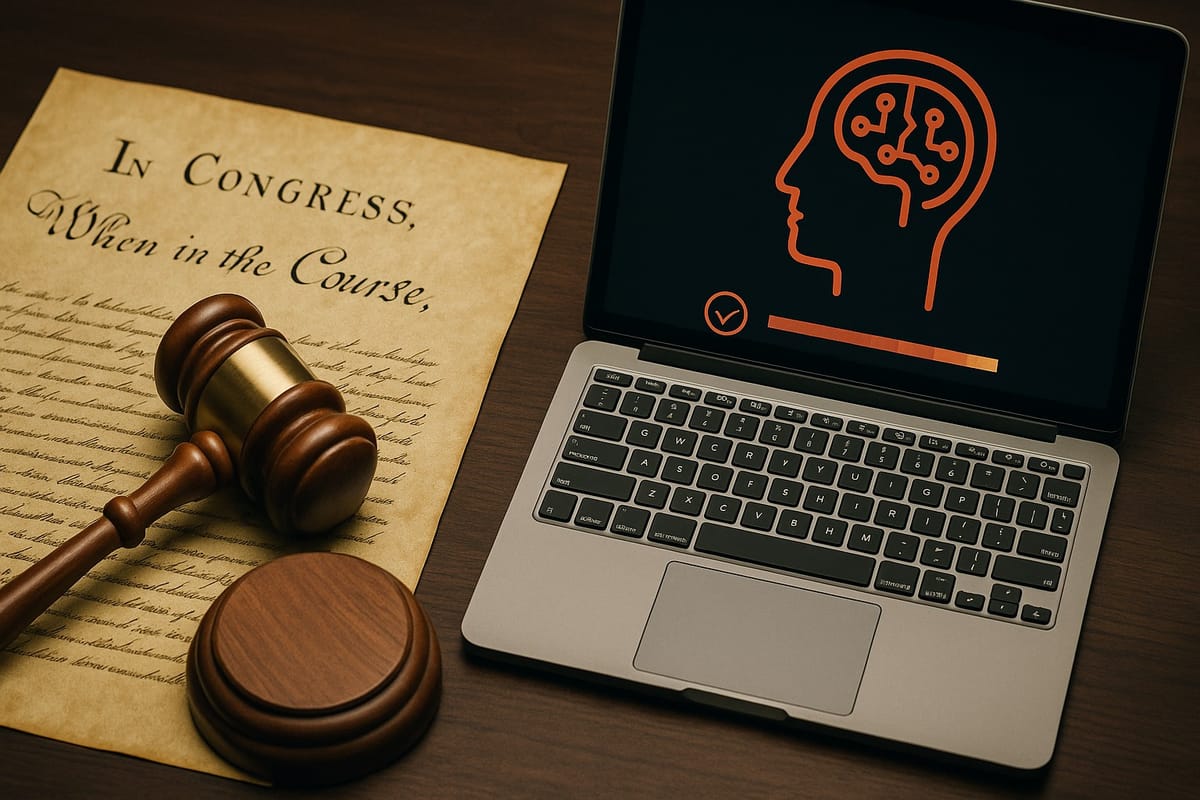
Something remarkable happened recently that should give us all pause. Several popular AI detection programs analyzed the Declaration of Independence and concluded with high confidence that Thomas Jefferson didn't write it. Instead, these tools declared that this cornerstone of American democracy was almost certainly produced by artificial intelligence. One detector assigned a ninety-five percent probability that the document was machine-generated.
The irony would be amusing if the implications weren't so troubling. Here was a text drafted in 1776, nearly two and a half centuries before anyone conceived of large language models, yet it was flagged as the work of modern software. To anyone with even basic historical knowledge, the verdict seemed absurd. But for researchers studying these detection systems, the result was entirely predictable and deeply revealing.
The Declaration exhibits qualities that eighteenth-century political writing prized. Its sentences unfold with deliberate symmetry. Its rhetoric builds through careful parallelism. Jefferson and his fellow drafters crafted their arguments using the formal conventions of Enlightenment prose, in which ideas were structured by logic and expressed in elevated language. These weren't flaws or accidents. They were features of sophisticated political communication in that era.
Modern AI detectors, however, interpret these same qualities as red flags. The systems work by analyzing statistical patterns in text and comparing them to patterns found in content generated by programs like ChatGPT or Claude. When writing appears too uniform, too polished, or too structurally consistent, the detectors assume a machine must have produced it. The fundamental problem becomes clear when you step back and consider what these tools measure. They aren't identifying authorship at all. They're identifying conformity to certain statistical regularities.
This confusion between pattern and provenance creates a devastating problem. Polished human writing across countless genres shares many characteristics with AI-generated text. Consider legal briefs, which follow strict formatting conventions and use precise language. Think about scientific papers, which maintain consistent terminology and logical flow. Reflect on great speeches throughout history, from Lincoln's Gettysburg Address to Martin Luther King Jr.'s "I Have a Dream," which employ deliberate repetition and rhythmic structure. All of these could trigger false positives in systems designed to detect machine-generated text.
The Declaration of Independence represents perhaps the most striking example, but it's far from unique. Researchers have tested these detectors on classic literature and found similar results. Shakespeare, Jane Austen, and Herman Melville have all been accused of being robots. The very qualities that make writing memorable and influential become evidence of fabrication in the eyes of these algorithmic judges.
The consequences of false positives extend beyond embarrassment; they threaten the integrity of education and journalism. When flawed detection tools wrongly accuse students and journalists, it raises ethical questions about trust, fairness, and the impact on professional reputations and credibility.
The dynamic plays out with cruel predictability. A student submits an essay that they researched carefully and drafted over several days. An instructor runs it through an AI detector. The tool returns a high probability score. Suddenly, the burden shifts entirely to the student, who must now prove their innocence. They may need to produce early drafts, show their browsing history, explain their writing process, or even recreate portions of the work under observation. The presumption of guilt displaces the presumption of good faith.
Journalists encounter similar problems. An investigative reporter spends weeks tracking down sources, verifying facts, and crafting a carefully structured article. Before publication, an editor runs the piece through a detection tool. A high score raises questions. Was AI involved? Can the reporter verify their process? The journalist's professional reputation hangs in the balance of a system with no forensic validity and no ability to distinguish between human excellence and machine output.
Professional writers face the strangest version of this predicament. Authors who have spent decades developing their craft, who write in distinctive voices honed through years of practice, suddenly find their own style flagged as suspicious. A novelist known for precise, lyrical prose receives notes from an agent or publisher questioning whether recent chapters were AI-generated. The very consistency that readers admire becomes evidence against authenticity.
The absurdity of demanding that authors demonstrate humanity through arbitrary conformity suggests the need for alternative approaches. Peer review, process documentation, or contextual evaluation could provide more reliable assessments, helping readers understand potential paths forward beyond flawed detection systems.
These problems don't affect everyone equally. The burden of proof falls hardest on those with the least institutional power. A student at a well-resourced university might have access to writing centers, detailed assignment feedback, and supportive faculty who understand the limitations of AI detection. A student at an underfunded community college may face an instructor who treats the detector's output as definitive, with no appeals process and no resources for mounting a defense.
International students face compounded challenges. Many write in English as a second or third language. They may naturally produce prose that seems unusually formal or structured because they learned academic English through careful study rather than native immersion. When a detection tool flags their work, they must navigate accusations while potentially dealing with language barriers, cultural differences, and the very real threat that academic misconduct findings could jeopardize their visa status.
Freelance writers and independent contractors operate without the protection of institutional employment. When a client questions the authenticity of their work based on a detector score, they may lose not just that assignment but the entire relationship. They have no HR department to appeal to, no union representation, and often no practical recourse beyond accepting the accusation or walking away from the income.
Understanding why AI detectors fail requires looking at how they work. These systems analyze linguistic patterns and compare them to statistical models of AI-generated text. Recognizing these limitations can inspire educators and policymakers to advocate for ethical reforms and more reliable assessment practices. Understanding why AI detectors fail requires looking at how they work. These systems analyze linguistic patterns and compare them to statistical models of AI-generated text. They look for markers such as consistent sentence length, regular vocabulary distribution, predictable transitions, and a uniform tone. When a piece of writing exhibits these traits, the detector assigns it a probability score suggesting machine authorship.
The problem is that human writing has always exhibited these same traits under certain conditions. Academic writing follows convention. Legal writing adheres to precedent. Technical documentation maintains consistency. Poetry employs deliberate structure. In each case, regularity serves a purpose and reflects human choices, not algorithmic generation.
AI detectors cannot account for context, intent, or the countless reasons why a human author might produce structured, polished prose. They treat writing as purely statistical data, stripped of the cultural, educational, and personal factors that shape how people communicate. A student who attended schools that emphasized grammar and organization will write differently from one who received less formal training. A professional editor's work will naturally be more polished than a first draft. A writer from a non-English background may rely more heavily on formal structures they were explicitly taught.
None of these variations indicates anything about authorship, but they can all affect how a detector scores a piece of text. The tools mistake correlation for causation; if AI often produces specific patterns, those patterns must indicate AI authorship. It's circular reasoning dressed up in probability scores.
Institutions and individuals need different approaches to navigate this landscape responsibly. The solution isn't better detectors or more sophisticated algorithms. The solution is to recognize that authorship cannot be reliably determined through statistical analysis alone and to build systems that reflect that reality.
Educational institutions can shift from surveillance to support. Instead of running student work through detectors and treating the results as evidence, instructors can build relationships with students throughout the writing process. Regular conferences on work in progress, discussions of research strategies, and reviews of evolving drafts create natural opportunities to understand how students think and work. This approach serves the actual goal of education better than trying to catch cheaters after the fact.
Assignments themselves can be redesigned to emphasize process over product. When students maintain research logs, submit annotated bibliographies, participate in peer review workshops, and turn in multiple drafts, they create a natural record of their intellectual engagement. These materials don't prove authorship in some forensic sense, but they demonstrate learning and development in ways that matter more than catching the occasional bad actor.
Professional environments need similar shifts. Publishing workflows can incorporate collaborative editing, version control, and transparent communication, making authorship apparent through the work itself rather than through automated vetting. News organizations can rely on established editorial relationships and professional standards rather than treating every submission as potentially fraudulent.
For individuals, the practical reality is that documentation provides the best protection in an environment where false accusations remain possible. Writers who keep early drafts, maintain timestamped files, use version control systems, or work in platforms that automatically track changes create evidence trails that can refute baseless claims. This shouldn't be necessary, but until institutions abandon unreliable detection tools, it remains prudent.
The deeper question is: what kind of culture do we want to create around writing and intellectual work? The rise of AI detection tools reflects a broader erosion of trust, where institutions assume guilt and demand proof of innocence rather than engaging with the substance of what people create.
This presumption of dishonesty carries costs beyond individual cases of misclassification. When students know their work will be scanned for signs of cheating, they may become more cautious about writing well. When journalists worry that polished prose will trigger suspicion, they may self-censor or deliberately introduce awkwardness. When authors fear that their natural voice could be mistaken for machine output, the incentive structure for good writing itself becomes warped.
We also risk normalizing a world in which machines judge human creativity by standards humans can barely articulate. If an AI detector flags something suspicious, what grounds do we have for trusting or rejecting that judgment? The systems are proprietary black boxes. Their training data is often unknown. Their error rates vary wildly. Their theoretical foundations remain contested even among researchers. Yet institutions treat their output as actionable intelligence.
The Declaration of Independence serves as a perfect test case precisely because we know with absolute certainty who wrote it and when. The fact that modern detectors can't recognize obvious human authorship in a foundational historical document should end any illusion that these tools work reliably. They don't. They can't. The task they claim to perform exceeds their actual capabilities by orders of magnitude.
As AI becomes more sophisticated and integrated into how people work, we need frameworks that acknowledge both its potential and its limitations. That means developing clearer policies on acceptable AI use across different contexts, rather than pretending we can keep it entirely separate through surveillance and detection.
In education, that might mean openly discussing how tools like ChatGPT can be used responsibly for brainstorming, editing, or exploring ideas, while being clear about what work must be original. In journalism, it might mean establishing standards for disclosure when AI assists in research or preliminary drafting. In creative fields, it might mean accepting that authors use diverse tools in their process while maintaining that the final vision and voice must be their own.
These approaches require trust and nuance, which makes them harder to implement than simply running everything through a detector and treating the results as definitive. But the more challenging path is the necessary one. We cannot build healthy institutions on the foundation of mutual suspicion and unreliable technology.
The future of writing depends on humans recognizing what machines can and cannot do, then acting on that knowledge with both honesty and humility. AI detectors cannot determine authorship. They can only identify statistical patterns that may or may not have the meanings we assume. Using them as gatekeepers or arbiters inevitably produces injustice.
Thomas Jefferson didn't need to prove he wrote the Declaration of Independence. His work stood on its own merits, shaped by specific historical circumstances and animated by ideas about human dignity and political legitimacy. When our technology suggests otherwise, failure lies with technology, not with the text. Remembering that distinction matters now more than ever.
BearNetAI, LLC | © 2024, 2025 All Rights Reserved
🌐 BearNetAI: https://www.bearnetai.com/
💼 LinkedIn Group: https://www.linkedin.com/groups/14418309/
🦋 BlueSky: https://bsky.app/profile/bearnetai.bsky.social
📧 Email: marty@bearnetai.com
👥 Reddit: https://www.reddit.com/r/BearNetAI/
🔹 Signal: bearnetai.28
Support BearNetAI
BearNetAI exists to make AI understandable and accessible. Aside from occasional book sales, I receive no other income from this work. I’ve chosen to keep BearNetAI ad-free so we can stay independent and focused on providing thoughtful, unbiased content.
Your support helps cover website costs, content creation, and outreach. If you can’t donate right now, that’s okay. Sharing this post with your network is just as helpful.
Thank you for being part of the BearNetAI community.
Books by the Author:
This post is also available as a podcast: