Your Smart Doorbell Is an AI-Enabled Surveillance Camera
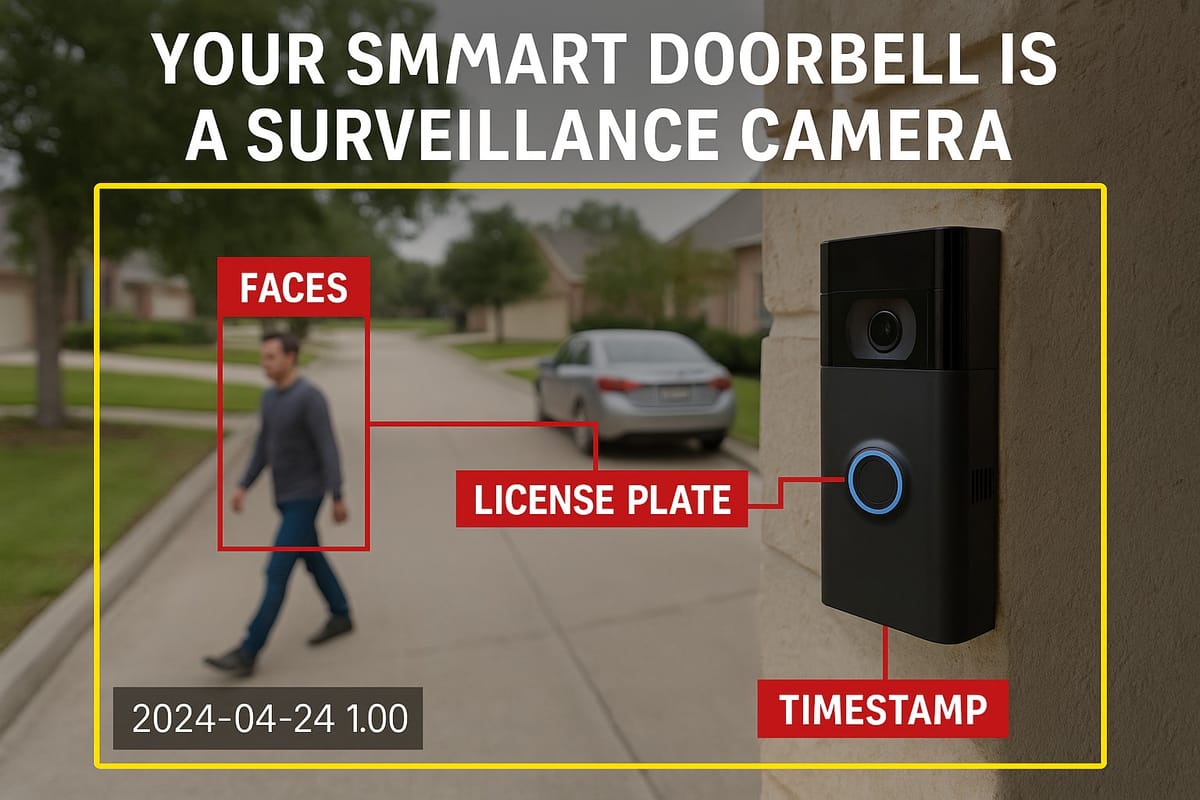
Your doorbell camera isn't just watching your porch. It's watching your neighborhood.
That's the part most people never think about. The camera aimed at your front steps is quietly capturing the entire street. Cars pass by as kids walk to school, and neighbors come home. Delivery drivers, dog walkers, and every unfamiliar face that happens to stroll past end up in the frame. What feels like a simple security upgrade has quietly become one of the largest decentralized surveillance networks in the country, and most of us installed it ourselves.
Smart doorbells aren't cameras in the traditional sense. They're intelligent sensors powered by machine learning that don't just record video but actively interpret what they see. Behind the scenes, many models can detect and identify faces, capture license plates from moving vehicles, and track patterns of movement over time. They distinguish between humans, animals, and vehicles and store all of this information indefinitely in the cloud.
This transforms ordinary home security devices into sophisticated data-gathering tools. It also fundamentally changes what surveillance means. It's no longer just a police camera mounted on a pole. It's the network of devices lining suburban streets every day, quietly collecting information about everyone who passes by, whether they were invited or not.
Police can request your doorbell footage without a warrant. In many cases, all they need to do is ask the device manufacturer, who can respond directly unless the user has explicitly denied future requests. Many people never see these requests. Others don't even realize they can opt out. You don't need to be suspected of a crime for your footage to be used.
Your doorbell camera may be documenting passersby, the vehicles they drive, the routes they take, and the timestamps that place them in specific locations at specific moments, all without your knowledge or permission. When multiplied across millions of homes, this creates something unprecedented. We now have a public-private surveillance network with no centralized oversight, no clear limits, and no consistent transparency, precisely because the cameras belong to individuals rather than the government.
While a single doorbell camera doesn't change society, millions of them do. When mapped collectively, doorbell cameras form a continuous, overlapping field of view across American neighborhoods. This creates near-total street coverage with time-stamped histories of movement, continuous footage of every person entering or exiting a community, and searchable databases of faces, vehicles, and behavior patterns.
This is not a hypothetical future. It exists today. It is the first surveillance grid in history built not by the state but by homeowners seeking peace of mind, only to discover later that they inadvertently became nodes in a nationwide monitoring system.
This raises important questions. Who controls this data? Who can access it? How long is it kept? What safeguards are there? What happens when these systems integrate with police databases, AI pattern recognition, and government monitoring tools? We have not meaningfully answered any of these questions. Yet the network continues to expand, camera by camera, porch by porch.
None of this means people shouldn't use smart doorbells. They absolutely have legitimate security value. They deter crime, protect packages, and help identify real threats.
But technology should make us safer without quietly erasing our expectations of privacy. The danger isn't the camera itself. It's the lack of transparency around how the data is used, who can request it, and what systems it feeds behind the scenes.
Smart doorbells give us convenience, awareness, and peace of mind. They also gave us a surveillance network we never intended to build. As AI becomes more powerful and these systems become more interconnected, we must decide where the line is drawn between safety and oversight, between security and surveillance, between being informed and being monitored. Before this network becomes too large, we should at least make sure the people living inside it understand that it exists.
BearNetAI, LLC | © 2024, 2025 All Rights Reserved
🌐 BearNetAI: https://www.bearnetai.com/
💼 LinkedIn Group: https://www.linkedin.com/groups/14418309/
🦋 BlueSky: https://bsky.app/profile/bearnetai.bsky.social
📧 Email: marty@bearnetai.com
👥 Reddit: https://www.reddit.com/r/BearNetAI/
🔹 Signal: bearnetai.28
Support BearNetAI
BearNetAI exists to make AI understandable and accessible. Aside from occasional book sales, I receive no other income from this work. I’ve chosen to keep BearNetAI ad-free so we can stay independent and focused on providing thoughtful, unbiased content.
Your support helps cover website costs, content creation, and outreach. If you can’t donate right now, that’s okay. Sharing this post with your network is just as helpful.
Thank you for being part of the BearNetAI community.
Books by the Author:
This post is also available as a podcast: