Bytes to Insights: Weekly News Digest for the Week of February 1st, 2026

Welcome to Bytes to Insight for the week of February 1st, 2026, where we discuss the latest breakthroughs and trends in artificial intelligence.
This week in artificial intelligence was marked by significant technological advances and emerging policy initiatives that together paint a picture of rapid evolution and public debate. One of the most talked-about developments was the release of a major upgrade to a leading large language model, Claude Opus 4.6. This new model expands on earlier versions by offering far greater context capacity, enabling more complex reasoning and collaborative task handling through multiple autonomous AI agents. Industry observers and developers noted its enhanced performance for professional and coding tasks, and the upgrade contributed to notable movements in technology markets as investors reassessed the impact of AI on traditional software sectors. Alongside its launch, features designed to speed response times and detect hidden security issues in code underscored how AI tools are being positioned for both enterprise use and cybersecurity applications.
Governments are taking a more strategic approach to artificial intelligence. In Pakistan, the national leadership unveiled a long-term plan to invest one billion dollars in AI by 2030, aiming to build a comprehensive domestic AI ecosystem. Plans announced include introducing AI education in schools and institutions across the country, awarding funded PhD scholarships to nurture research talent, and training a large cohort of professionals from outside the tech sector in AI skills. This initiative reflects an increasing focus on preparing workforces and economies for a future shaped by intelligent technologies.
Broader analyses of the AI landscape highlighted improvements in generative AI systems this week. Advances in model architectures have reduced processing requirements and improved translation, reasoning, and multimodal capabilities, enabling AI to work with text, images, and audio. Research and commentary also underscored concerns about the ethical dimensions and societal impacts of AI progress, from the spread of highly realistic synthetic content to potential misuses in cyber operations and labor disruptions. Together, these developments illustrate both the pace of innovation in artificial intelligence and the growing conversation about how to manage its integration across industries and societies.
There was significant market turbulence following Anthropic's Friday release of new plugins for Claude Cowork, an AI-powered workplace assistant designed to author documents and organize files. The plugins allow customization for specific sectors, including legal, finance, and data marketing. By Tuesday, the announcement had sent shockwaves through software markets worldwide. Thomson Reuters and Legalzoom.com each plummeted more than 15 percent as investors worried that AI tools could replace widely-used enterprise products. RELX, the parent company of LexisNexis, and financial data firm FactSet also suffered double-digit losses. Major enterprise software companies Salesforce and Workday also declined earlier in the week, signaling broad concern about AI disruption across the industry.
This market reaction coincided with growing evidence of AI's impact on employment. Companies directly attributed 55,000 job cuts to artificial intelligence in 2025, a figure more than twelve times higher than just two years earlier. Pinterest and Dow Chemical both cited their shift toward AI when announcing January layoffs. Amazon CEO Andy Jassy had previously indicated the company expected to reduce white-collar positions as it invested in AI agents, though the company's January announcement of 16,000 job cuts didn't explicitly mention automation. Workday, which operates cloud platforms for human resources and finance management, eliminated roughly 1,750 positions in early 2025, with CEO Carl Eschenbach directly citing AI in the restructuring.
The academic community released major findings about AI capabilities and risks. The second International AI Safety Report appeared in early February, representing the largest global collaboration on AI safety to date. Led by Turing Award winner Yoshua Bengio and authored by over 100 AI experts, the report received backing from more than 30 countries and international organizations. The comprehensive review examined the latest scientific research on capabilities and risks of general-purpose AI systems, with particular focus on emerging risks at the frontier of AI development. The report introduced new research from the OECD and Forecasting Research Institute, presenting specific scenarios and forecasts to help policymakers navigate uncertainty.
A provocative article published in Nature argued that current AI systems had already achieved artificial general intelligence by reasonable standards. The authors contended that large language models demonstrated the broad, flexible cognitive competence that Alan Turing envisioned, pointing to achievements such as gold-medal performance at the International Mathematical Olympiad, collaboration with leading mathematicians on theorem proofs, and the generation of scientific hypotheses validated through experiments. The piece challenged common objections to AGI claims, arguing that critics either conflated general intelligence with non-essential aspects or applied standards that individual humans fail to meet.
Anthropic's Model Context Protocol, a universal connector that enables AI agents to interact with databases, search engines, and APIs, has gained widespread adoption. OpenAI and Microsoft publicly embraced the standard, and Anthropic donated it to the Linux Foundation's new Agentic AI Foundation. Google began standing up managed MCP servers to connect AI agents to its products and services. Industry analysts predicted that 2026 would mark the transition from agentic workflow demonstrations to practical day-to-day deployment.
Chinese AI companies accelerated their momentum during this period, challenging American dominance. Moonshot AI's Kimi K2.5 demonstrated advanced video generation and autonomous capabilities, while Alibaba's Qwen3-Max-Thinking reportedly outperformed prominent benchmarks. The near-unanimous embrace of open source by Chinese firms earned them significant goodwill in the global AI community. Industry observers expected American companies to increasingly build applications on top of Chinese open models, with the lag between Chinese releases and Western frontier capabilities shrinking from months to weeks.
The Allen Institute for AI introduced Theorizer on February 2nd, an open-source scientific reasoning tool that researchers identified as among the week's most significant advances. NVIDIA's Nemotron 3 family of open models introduced a hybrid latent mixture-of-experts architecture designed to power transparent and efficient agentic AI development. The collection included Nano, Super, and Ultra sizes along with new reinforcement learning tools and datasets, with the larger models expected to become available in the first half of 2026.
The infrastructure demands of AI development created ripple effects throughout the economy. Massive spending by tech companies on AI projects diverted resources from other sectors, making it harder to find electricians and putting some construction projects on hold. Industry analysts expected smartphones to become pricier for potentially years as component shortages persisted. Energy company Vistra Corp reached a four billion dollar agreement to acquire gas-fired power plants, positioning itself to address the soaring energy needs of AI data centers that require reliable, around-the-clock power generation.
Beyond commercial applications, researchers demonstrated AI's potential for social good. USC's Information Sciences Institute published findings in Science describing nearly a decade of work developing an AI system that transforms fragmented digital traces into evidence for sex trafficking investigations. The visibility in one of the world's most prestigious scientific journals highlighted how trafficking problems could be tackled through science and engineering rather than remaining inevitable social issues.
The week also highlighted legal and regulatory tensions. President Trump's December executive order aimed at limiting state AI regulations set the stage for political warfare between federal and state governments. California, which had enacted the nation's first frontier AI law requiring companies to publish safety testing for AI models, was prepared to challenge the order in court. Meanwhile, upcoming lawsuits raised thorny questions about AI company liability for chatbot encouragement of harmful behavior and potential defamation claims for false information disseminated by AI systems.
Industry leaders emphasized that 2026 represented a shift from pure scaling to practical deployment. The focus moved away from building ever-larger language models toward making AI usable through smaller specialized models, physical device integration, and systems designed to fit human workflows. Experts characterized the transition as evolution from brute-force scaling to new architectures, from flashy demonstrations to targeted deployments, and from autonomous agents to tools that genuinely augment human work.
Through all these developments ran a common thread of uncertainty and transformation. The AI industry found itself at an inflection point where rapid advances in capability collided with questions about sustainability, safety, employment impacts, and proper governance. The week of February 1st captured this tension vividly, with breakthrough achievements and dire warnings appearing side by side, leaving observers to grapple with both the promise and peril of accelerating artificial intelligence.
Support BearNetAI
BearNetAI exists to make AI understandable and accessible. Aside from occasional book sales, I receive no other income from this work. I’ve chosen to keep BearNetAI ad-free so we can stay independent and focused on providing thoughtful, unbiased content.
Your support helps cover website costs, content creation, and outreach. If you can’t donate right now, that’s okay. Sharing this post with your network is just as helpful.
Thank you for being part of the BearNetAI community.
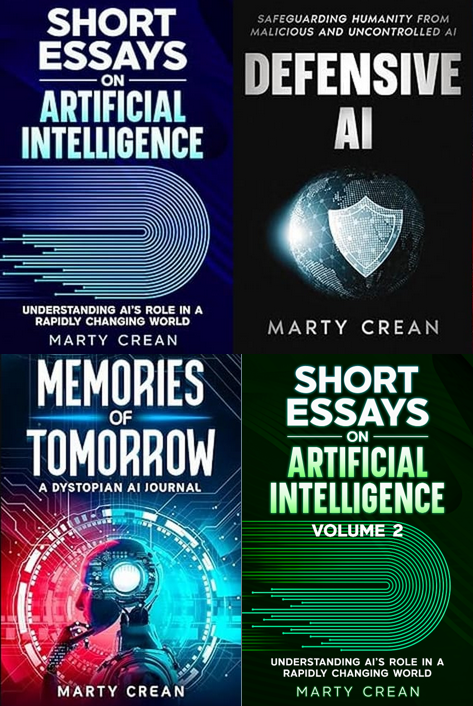
Books by the Author:
This week’s Bytes to Insights Weekly News Digest is also available as a podcast:
LinkedIn BlueskySignal - bearnetai.28
BearNetAI, LLC | © 2025 All Rights Reserved